



The global economy is entering a period of slower growth shaped by two powerful and opposing forces: geopolitical conflict and rapid technological expansion.
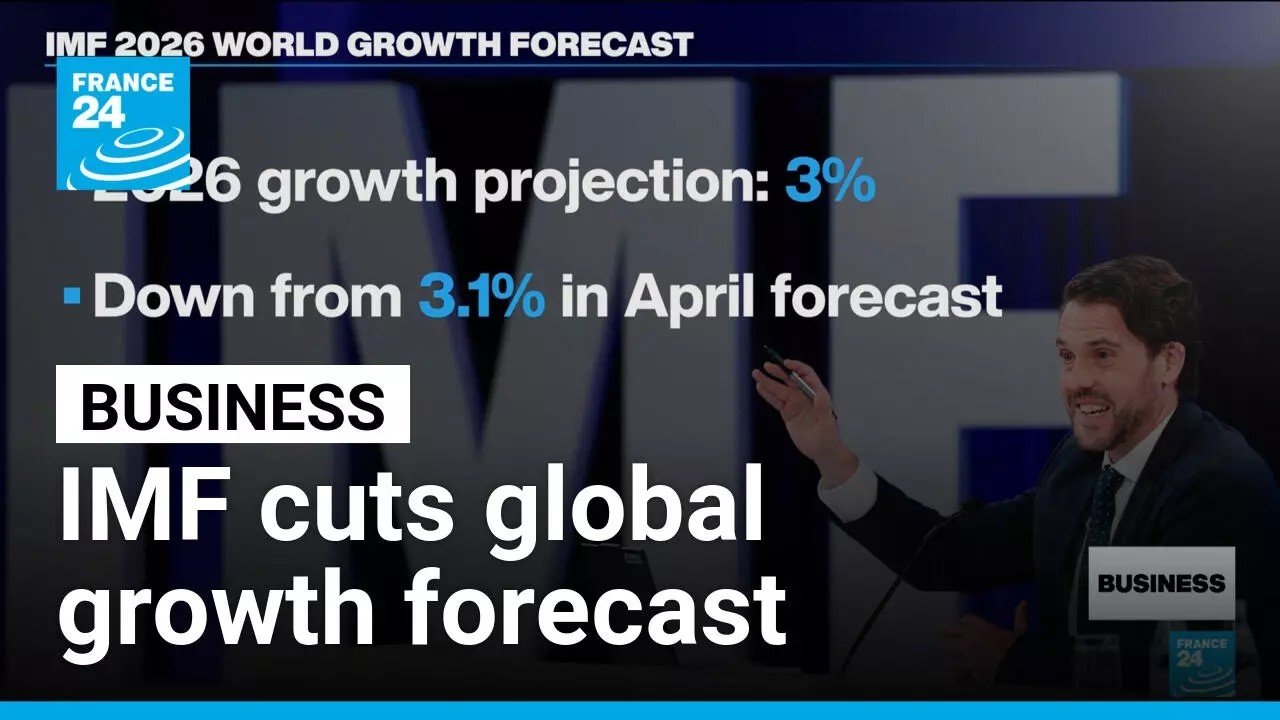
In its latest World Economic Outlook Update released on July 8, 2026, the International Monetary Fund (IMF) projects global growth will slow to 3.0% in 2026, down from 3.5% in 2025, before rebounding to 3.4% in 2027.
The report titled “Global Economy in Crosscurrents of War and Technology” underscores how the ongoing conflict in the Middle East is weighing heavily on economic activity, even as a surge in artificial intelligence (AI) investment helps cushion the impact.
The global economy has been broadly resilient to the shock from the war in the Middle East. The impact has been uneven, affecting energy supplies, food security, commodities, and economic activity, while raising concerns about growth and price stability. https://t.co/BztJ3ngZIR
— Kristalina Georgieva (@KGeorgieva) July 8, 2026
War and technology pull in opposite directions
The IMF highlights a stark divergence in global economic drivers.
On one side, the war-related energy shock has pushed oil and gas prices roughly 25% above pre-conflict levels, exacerbated by disruptions in key supply routes such as the Strait of Hormuz. This has placed significant strain on energy-importing economies, particularly in Europe and parts of Asia.
On the other, a boom in AI and technology investment is acting as a counterbalance. Massive capital expenditure in data centers, semiconductors, and AI infrastructure is boosting productivity and supporting growth in major technology hubs, preventing a sharper global slowdown.
The IMF notes that countries’ economic outcomes increasingly depend on their exposure to these two forces—whether they are vulnerable to energy shocks or positioned to benefit from the AI-driven investment cycle.
Inflation and trade pressures persist
Inflation is proving more stubborn than expected. The IMF now forecasts global inflation at 4.7% in 2026, revising earlier estimates upward due to rising energy and commodity prices. This marks a pause in the disinflation trend that had been underway since 2024. Inflation is expected to ease to 3.9% in 2027.
Global trade is also slowing. Growth in trade volumes is projected to drop to 3.5% in 2026, down sharply from 5.0% in 2025, reflecting weaker demand and ongoing geopolitical fragmentation. A modest recovery to 4.3% is expected in 2027.
Uneven regional performance
The outlook varies significantly across major economies:
- United States: 2.3% growth, supported by strong AI investment and relative insulation from energy shocks due to domestic oil production.
- Euro Area: 0.9% growth, downgraded due to heavy exposure to higher energy costs.
- United Kingdom: 1.0% growth, slightly upgraded as resilience exceeded earlier expectations.
- China: 4.6% growth, buoyed by strength in technology manufacturing.
- India: 6.4% growth, remaining one of the fastest-growing major economies despite a slight downgrade.
- Japan: 0.6% growth, constrained by domestic structural challenges.
- Middle East and Central Asia: 0.7% growth, sharply reduced due to direct conflict impacts, though a strong rebound is expected in 2027.
Risks tilt to the downside
Despite relative resilience so far, the IMF warns that risks remain firmly skewed to the downside.
A renewed escalation in the Middle East conflict could trigger further energy price spikes, particularly if supply routes face additional disruptions. With strategic reserves already depleted in several countries, the global economy would have limited buffers against another shock.
At the same time, financial markets are increasingly tied to expectations around AI. A sharp correction in technology valuations or a slowdown in AI-related returns could dampen investment and stall growth momentum globally.
A fragile balance
The IMF’s latest outlook paints a picture of a global economy holding steady—but only just. The balance between geopolitical instability and technological acceleration will likely define economic performance in the years ahead.
For policymakers and investors alike, the challenge will be navigating a world where war-driven volatility and innovation-led growth are unfolding at the same time, pulling the global economy in opposite directions.
IMF names new Chief Economist
The IMF also announced a leadership change in its research department, naming Silvana Tenreyro as its next chief economist and head of research. She will succeed Pierre-Olivier Gourinchas and is set to take up the role on August 10.