
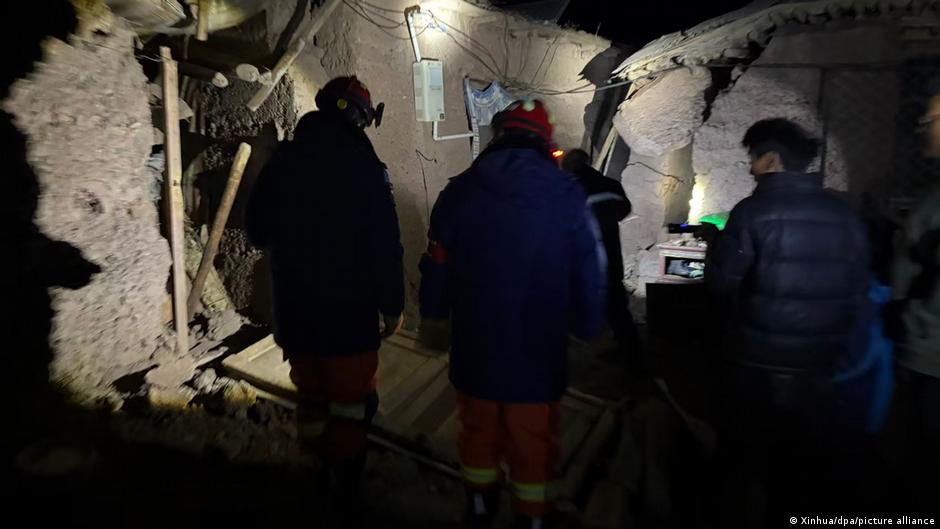










More than 12,000 residents have been evacuated after a magnitude 7.0 earthquake struck northern Tibet, with relief teams supplying shelter, medical care and clean water in the high-altitude disaster zone.
A magnitude 7.0 earthquake that struck northern Tibet late on Thursday, October 22, has killed at least 16 people and injured 76, according to Chinese authorities, as rescue and relief teams work to support thousands of displaced residents in freezing conditions.
The earthquake hit Baqên County in the Nagqu administrative area at 10:33 p.m. local time. The US Geological Survey placed its epicentre 191 kilometres east-northeast of Nagqu at a depth of 18 kilometres.
At least 339 homes collapsed, and more than 12,000 residents were evacuated, according to Chinese state media cited by the Associated Press. Officials warned that aftershocks could bring down damaged buildings and trigger further rockslides.
By Monday, October 26, the reported death toll remained at 16, while authorities continued relief operations and expanded medical services, drinking-water testing and sanitation measures at temporary resettlement sites.
Survivors fled into the cold
The late-night earthquake forced residents out of their homes as buildings shook and electricity supplies failed. Some spent the night in tents or cars in subzero temperatures, fearing that further tremors could trap them inside damaged houses, the BBC reported, citing local accounts.
Yixi Cuomu, a Nagqu resident interviewed by Tibet Daily, said she had been asleep when her home began shaking violently. She fled barefoot, describing her legs as “trembling uncontrollably” as she went down the stairs, according to the BBC’s account.
Earlier reports put the number of injured at 54 or 65. An updated Associated Press report on Friday gave a figure of 76, which was also reported by Xinhua on Monday. Eleven people were described as seriously injured in earlier reporting.
Officials said rescuers had completed three rounds of house-to-house and village-by-village searches by Friday afternoon. No one was reported missing in Baqên County at that stage, according to the Associated Press.
Rockfalls and altitude complicated the response
The affected area lies at an average elevation of nearly 4,800 metres, where low temperatures and difficult terrain have complicated rescue and relief work. Rockfalls blocked roads, while electricity and communications outages disrupted the initial response.
A section of National Highway 317 was restricted to emergency, rescue and official support vehicles while crews cleared debris. Railway authorities also halted trains passing through the region as an emergency precaution, according to Xinhua reporting cited by the Associated Press.
More than 5,000 rescue personnel had been deployed at different levels by Monday, according to Xinhua. That figure was substantially higher than the initial deployment of 1,600 rescuers reported shortly after the earthquake.
Relief supplies reported to have reached the region by Friday included 2,000 prefabricated housing units, around 3,400 tents and 2,000 folding beds, alongside winter clothing and flashlights. Forecasts of intermittent snow over the following days added urgency to efforts to shelter displaced families.
Medical care and clean water become priorities
As relief operations continued, health teams began monitoring more than 3,600 residents across 35 resettlement sites for infectious diseases, according to the Nagqu earthquake relief headquarters. Their work included disinfecting public areas and testing drinking water.
Mobile medical stations were established at several sites to treat minor injuries and common illnesses, provide medicines and offer basic psychological counselling. Xinhua reported that temporary shelters were being heated with stoves as residents faced the plateau’s late-October cold.
Emergency facilities introduced on Saturday included a mobile kitchen, a water-purification station and a waterless toilet system. In Maru Township, purification equipment capable of treating two tonnes of well water an hour had been supplied to five administrative villages, with further coverage planned, according to the same report.
Why the earthquake struck
The USGS attributed the earthquake to normal faulting within the Tibetan Plateau—a type of movement associated with the crust stretching and one side of a fault slipping downward relative to the other.
Although the collision between the Indian and Eurasian tectonic plates drives the uplift of the Himalayas and Tibetan Plateau, the plateau also spreads eastward and westward under its own immense weight. The USGS said the fault movement in Thursday’s earthquake was consistent with that east-west stretching.
The agency estimated that approximately 111,000 people experienced moderate to severe shaking. It also warned that aftershocks could produce further strong shaking.
Chinese state media reported more than 400 aftershocks by Friday morning. Separately, the USGS recorded at least seven aftershocks ranging from magnitude 4.3 to 5.2, according to the Associated Press. Those figures describe different reported sets of tremors and should not be treated as interchangeable totals.
Limits on independent reporting
Most casualty, damage and relief figures have come from Chinese authorities and state media. The BBC noted that restrictions on foreign media access to Tibet make independent reporting difficult, leaving official outlets as the principal source of information about the disaster.