


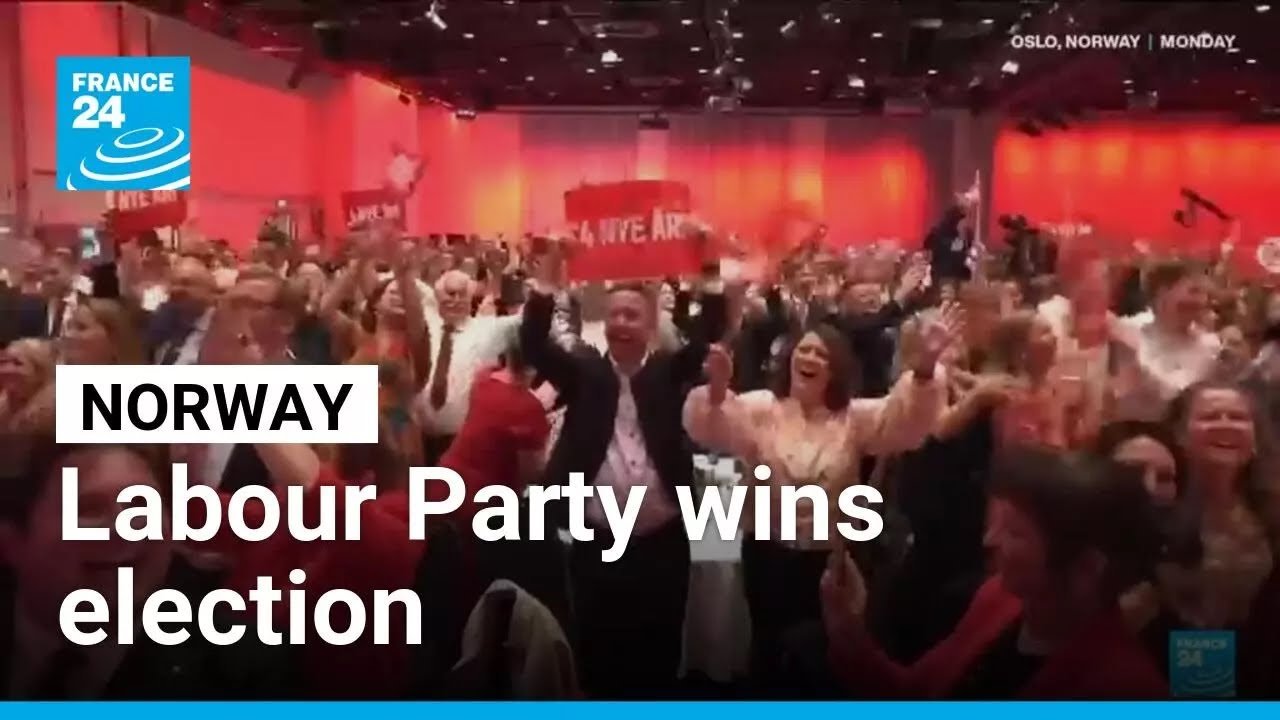
Norway’s ruling centre-left bloc secured a narrow victory in the country’s parliamentary elections on 8 September 2025, returning Prime Minister Jonas Gahr Støre to power amid a fragmented political landscape and rising support for populist parties.
Norway held elections for all 169 seats in the Storting, its national parliament, following an advance voting period that ran from 11 August to 5 September.
The centre-left “Red-Green” bloc retained its parliamentary majority with 88 seats, led by Støre’s Labour Party, which secured 28.2% of the vote and 53 seats. The coalition continues to rely on support from allied parties including the Centre Party, Socialist Left, Greens, and Red Party.
Despite the overall victory, the result reflected a more fractured political environment. The right-wing Progress Party emerged as the largest opposition force, gaining 47 seats — an increase of 27 and the strongest performance in its history. Meanwhile, the Conservative Party, led by former prime minister Erna Solberg, fell to third place with 14.6% of the vote, its weakest showing in over a decade.
Labour’s win followed a late surge in support after trailing in earlier polls, with analysts partly attributing the turnaround to the return of former NATO chief Jens Stoltenberg as finance minister earlier in the year.
Voter turnout reached 78.8%, the highest since 1989, reflecting heightened public engagement.
Key issues
The campaign was shaped by a combination of domestic economic pressures and growing geopolitical uncertainty.
Rising living costs dominated voter concerns, as inflation and higher interest rates strained household budgets. Debate centred on how much of Norway’s roughly $2trillion sovereign wealth fund should be deployed to ease economic pressures without exacerbating inflation.
The country’s long-standing wealth tax emerged as a defining dividing line. Right-leaning parties argued for its reduction or abolition, warning it was driving capital and entrepreneurs abroad, while the Labour-led bloc defended it as essential to maintaining social equity and funding public services.
Geopolitics played an unusually prominent role. Norway’s position as a major gas supplier to Europe, alongside its border with Russia, heightened the salience of security issues. Stoltenberg’s return was widely seen as reinforcing the government’s credibility on both defence and economic management.
Foreign policy debates also extended to the Middle East, with divisions over Norway’s recognition of Palestine and calls to divest the sovereign wealth fund from Israeli-linked assets.
Energy policy further exposed tensions within the political spectrum. While some parties pushed for stricter limits on oil and gas exploration to meet climate goals, others emphasised the need to sustain production to support Europe’s energy security. Disputes over EU energy rules had already strained the governing coalition earlier in the year.
Social issues, including immigration, crime, and debates around gender and identity, also featured prominently, particularly in the Progress Party’s campaign messaging.
Political reaction
Støre framed the result as a broader signal beyond Norway, arguing that social democracy remains electorally viable despite a wider shift toward right-wing politics in Europe. Supporters pointed to stability and continuity as key factors behind the outcome.
Within Labour, the role of Stoltenberg was widely credited with restoring confidence in the party’s leadership, particularly among younger voters.
The Progress Party, despite remaining in opposition, declared the result a success after significantly expanding its support. Leader Sylvi Listhaug said the party had “reason to feel like winners,” while warning of economic challenges under the returning government.
By contrast, the Conservatives faced internal reckoning after a historically poor performance. Solberg publicly acknowledged responsibility and signalled a period of rebuilding in opposition, as analysts pointed to voter hesitation over a potential alliance with the more hardline Progress Party.
Broader implications
International observers highlighted the high voter turnout as a sign of strong democratic engagement, while noting concerns about campaign financing rules.
Analysts broadly interpreted the result as a preference for continuity and stability at a time of geopolitical uncertainty, particularly given tensions involving Russia and shifting global economic dynamics.
The election also marked a milestone for Norway’s environmental politics, with the Green Party crossing the electoral threshold for the first time, a development expected to increase pressure on the government to adopt a firmer stance on climate policy and oil exploration.
Read also:
11 pivotal elections that altered the global outlook in 2025
Poland Presidential Election: PiS’s Nawrocki beats Warsaw mayor
Romania Presidential Election: Centrist Nicușor Dan wins do-over
Portuguese General Election: Montenegro’s AD grabs the most seats

