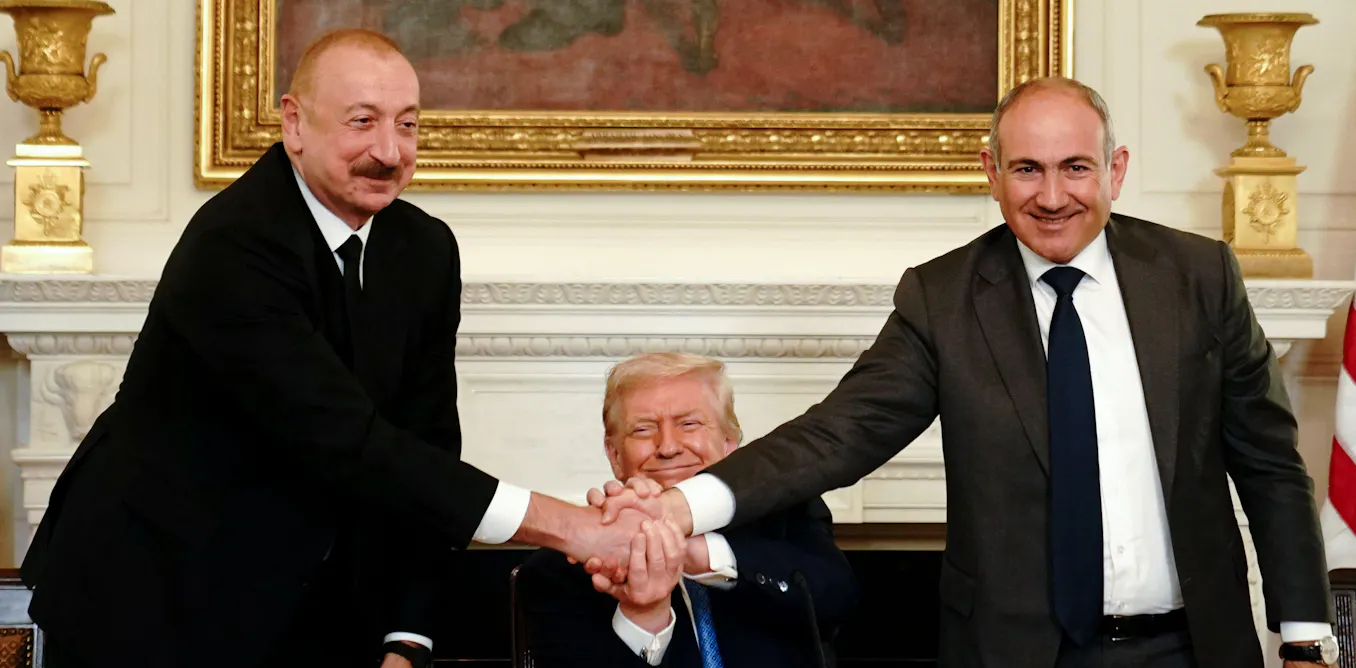
Armenia and Azerbaijan took a significant step toward ending decades of conflict in August 2025 by initialling a US-brokered agreement aimed at normalising relations, though key issues remain unresolved.
On 8 August 2025, Armenian Prime Minister Nikol Pashinyan and Azerbaijani President Ilham Aliyev initialled a draft “Agreement on the Establishment of Peace and Interstate Relations” during a summit mediated by US President Donald Trump.
It’s a long time, 35 years they fought, and now they’re friends, and they’re going to be friends for a long time.
US President Donald Trump at the White House Summit
The framework commits both sides to recognising each other’s territorial integrity, based on the 1991 Alma-Ata Declaration, and to formally ending decades of hostilities linked to the Nagorno-Karabakh conflict.
A central component of the deal is a proposed transport corridor linking Azerbaijan to its Nakhchivan exclave via Armenian territory. The route, referred to as the Trump Route for International Peace and Prosperity (TRIPP), would be developed with US involvement and is intended to boost regional connectivity and trade.
The sides also issued a joint declaration pledging to renounce future conflict, while Armenia signed a parallel agreement with the United States to advance infrastructure and transit initiatives under its “Crossroads of Peace” strategy.
What led to this
The agreement builds on a breakthrough reached in March 2025, when both countries finalised the text of a draft peace deal after years of intermittent negotiations.
However, progress stalled as Azerbaijan pushed for additional conditions, including constitutional changes in Armenia to remove references seen as implying territorial claims over Nagorno-Karabakh.
Tensions remained high in the months leading up to the August summit, with sporadic border incidents and competing geopolitical alignments. Armenia signalled closer ties with the European Union, while the United States stepped in to broker a more concrete solution to unresolved transit disputes.
The introduction of the TRIPP corridor addressed one of the most contentious issues, offering a defined mechanism for cross-border connectivity.
Status and challenges
Despite the breakthrough, the agreement remains preliminary. It has been initialled but not formally signed or ratified, leaving several legal and political hurdles.
Azerbaijan continues to insist on constitutional changes in Armenia as a condition for finalisation, a move that could require a national referendum. This has made the timeline for full implementation uncertain.
The deal has also drawn criticism within Armenia, with some groups arguing it compromises national sovereignty and fails to address accountability for past conflict.
Regionally, the proposal has raised concerns from neighbouring powers. Both Russia and Iran have expressed unease over increased US involvement and the implications of a US-linked transit corridor in the South Caucasus.
Broader implications
The agreement represents one of the most serious attempts in decades to normalise relations between Armenia and Azerbaijan, but its success will depend on whether both sides can navigate domestic political constraints and external geopolitical pressures.
If implemented, the corridor and broader peace framework could reshape trade routes and power dynamics in the region. However, unresolved disputes and competing interests continue to pose significant risks to a lasting settlement.
Today is a historic day, and also because we are bringing peace. President Trump is bringing peace to Caucasus, and we are grateful for that. And I’m sure that Armenia Azerbaijan, will find courage and responsibility to reconcile, and the people will also reconcile. We will turn the page of standoff, confrontation and bloodshed and provide bright and safe future for our children.
Azerbaijan President Ilham Aliyev
I’m particularly thrilled that, together with the US, Armenia, will work to bring to life the TRIPP Trump Route for Peace and Prosperity – connectivity project that will unlock the entire region. TRIPP will unlock strategic economic opportunities that will create long term benefits. It will promote infrastructure investment, enhanced regional connectivity and strengthen US leadership as a champion of conflict resolution.
Armenian Prime Minister Nikol Pashinyan


Read also:
US and Armenia sign landmark nuclear cooperation deal
10 Major Events That Shaped Geopolitics in 2025