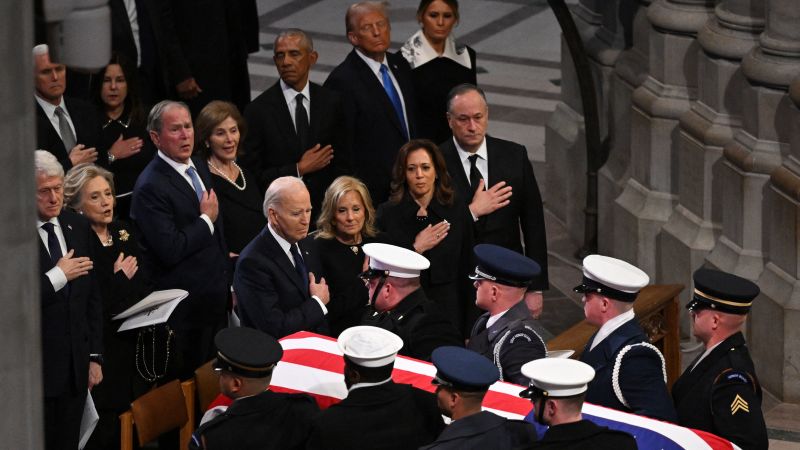
The United States paid tribute to former President Jimmy Carter with an extensive six-day state funeral in January 2025, marking the end of a century-long life that reshaped both American politics and global humanitarian work.
Carter, who died on December 29, 2024, at the age of 100, was the longest-lived US president and had the longest post-presidency in American history.
A ceremonial farewell in Washington
The state funeral proceedings began on January 7, when Carter’s casket was flown to Joint Base Andrews aboard a presidential aircraft designated “Special Air Mission 39,” a tribute to his place as the 39th president. From there, a horse-drawn caisson carried his remains to the US Capitol, where he lay in state in the Rotunda until January 9.
Thousands of mourners, including lawmakers, dignitaries, and members of the public, paid their respects.
The official state funeral took place at the Washington National Cathedral on January 9, drawing all five living US presidents — Joe Biden, Donald Trump, Barack Obama, George W. Bush, and Bill Clinton—alongside international leaders.
Eulogies spanning generations
President Joe Biden delivered the primary eulogy, honoring Carter’s lifelong commitment to peace, human rights, and public service.
In a rare and symbolic moment, a eulogy written decades earlier by former President Gerald Ford — who died in 2006 — was read aloud by his son, reflecting a pact between the two leaders to honour each other. Similarly, a tribute written by former Vice President Walter Mondale, who died in 2021, was delivered by his son, highlighting Carter’s early warnings on climate change.
A life beyond the presidency
Carter’s legacy extended far beyond his single term in office from 1977 to 1981.
A US Naval Academy graduate, he served in the Navy’s nuclear submarine program before returning home to Georgia to run his family’s peanut business. He later entered politics, serving as governor of Georgia, where he declared that the “era of segregation was over.”
As president, Carter brokered the landmark Camp David Accords between Egypt and Israel, established diplomatic relations with China, and signed the SALT II nuclear arms treaty with the Soviet Union. Domestically, he created the Departments of Energy and Education and advanced environmental protections.
Despite these achievements, his presidency was overshadowed by economic challenges and the Iran hostage crisis, culminating in his defeat by Ronald Reagan in 1980.
A humanitarian legacy
Carter’s post-presidency redefined what former leaders could accomplish.
Through the Carter Center, founded in 1982, he worked on conflict resolution, election monitoring, and disease eradication, including efforts to combat Guinea worm. His contributions earned him the Nobel Peace Prize in 2002.
Alongside his wife, Rosalynn Carter, he also dedicated decades to Habitat for Humanity, personally helping build homes for families in need.
Final return to Plains
Following the national ceremonies, Carter was returned to his hometown of Plains, Georgia, for a private burial beside Rosalynn, his wife of 77 years.
A US Navy “Missing Man” flyover honored his military service, while a bell rang 39 times at his childhood home, marking his presidency.
In a rare gesture, current and former Secret Service agents who had protected Carter served as pallbearers during the Georgia ceremonies.
Moments that stood out
The funeral also featured personal and symbolic moments that captured Carter’s character and legacy.
Musicians Garth Brooks and Trisha Yearwood performed John Lennon’s “Imagine,” reflecting Carter’s lifelong emphasis on peace.
Observers noted interactions among political figures, including a light exchange between Donald Trump and Barack Obama, while other moments underscored ongoing political divides.
Carter’s grandson, Jason Carter, drew laughter by calling him the “first millennial,” citing his early advocacy for renewable energy and reforms that contributed to industries like affordable air travel.