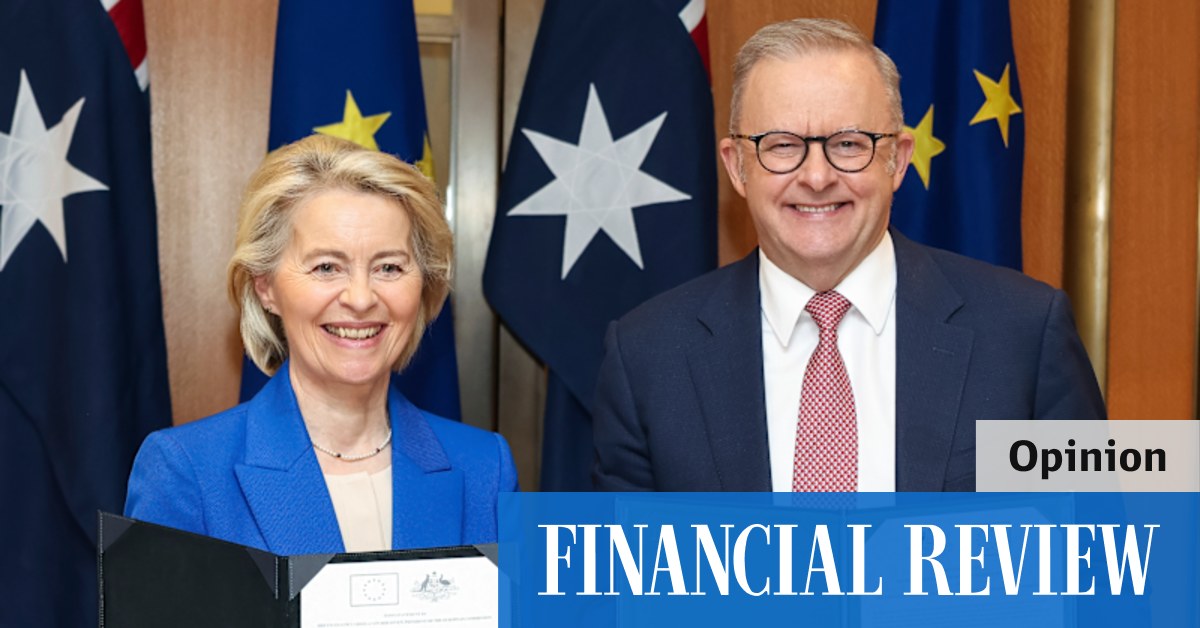
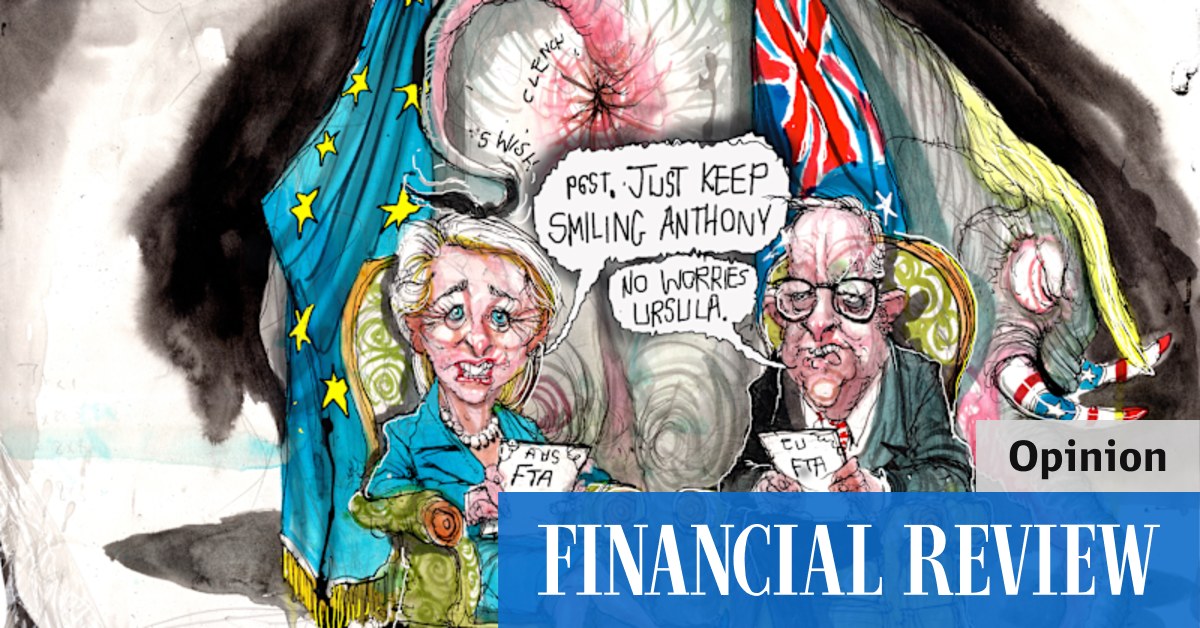
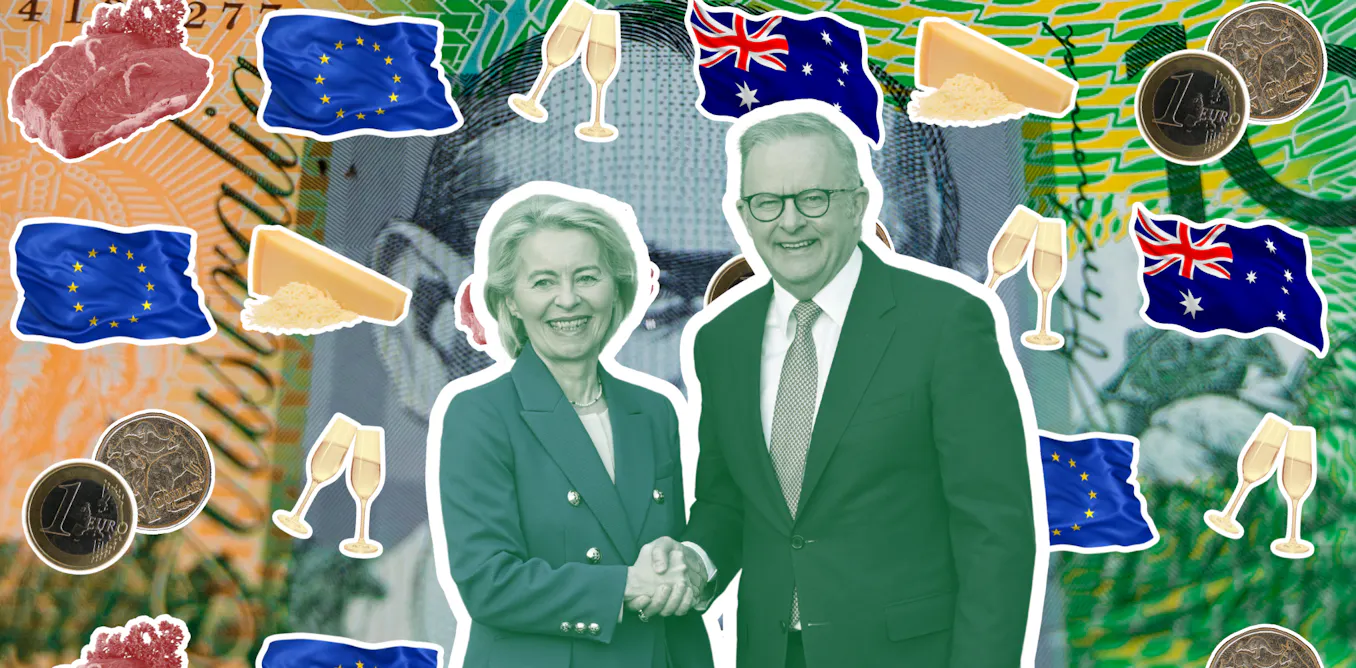
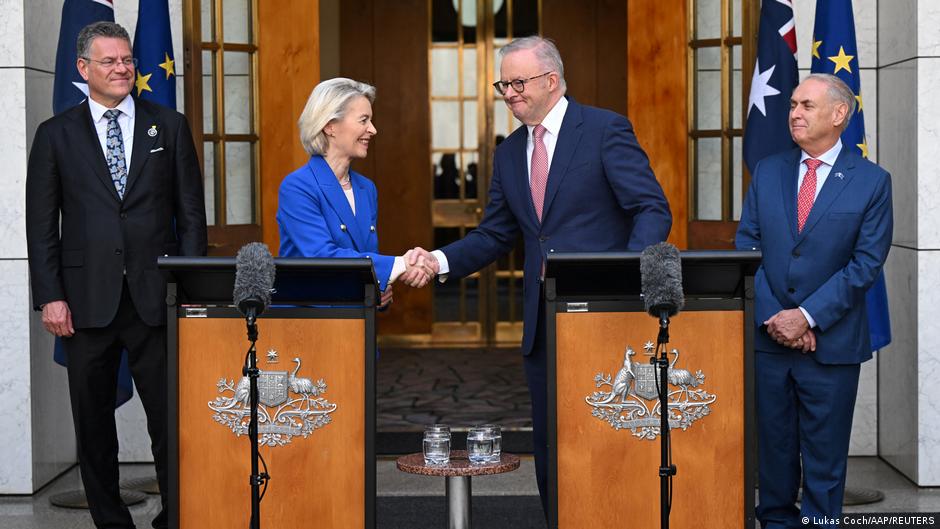
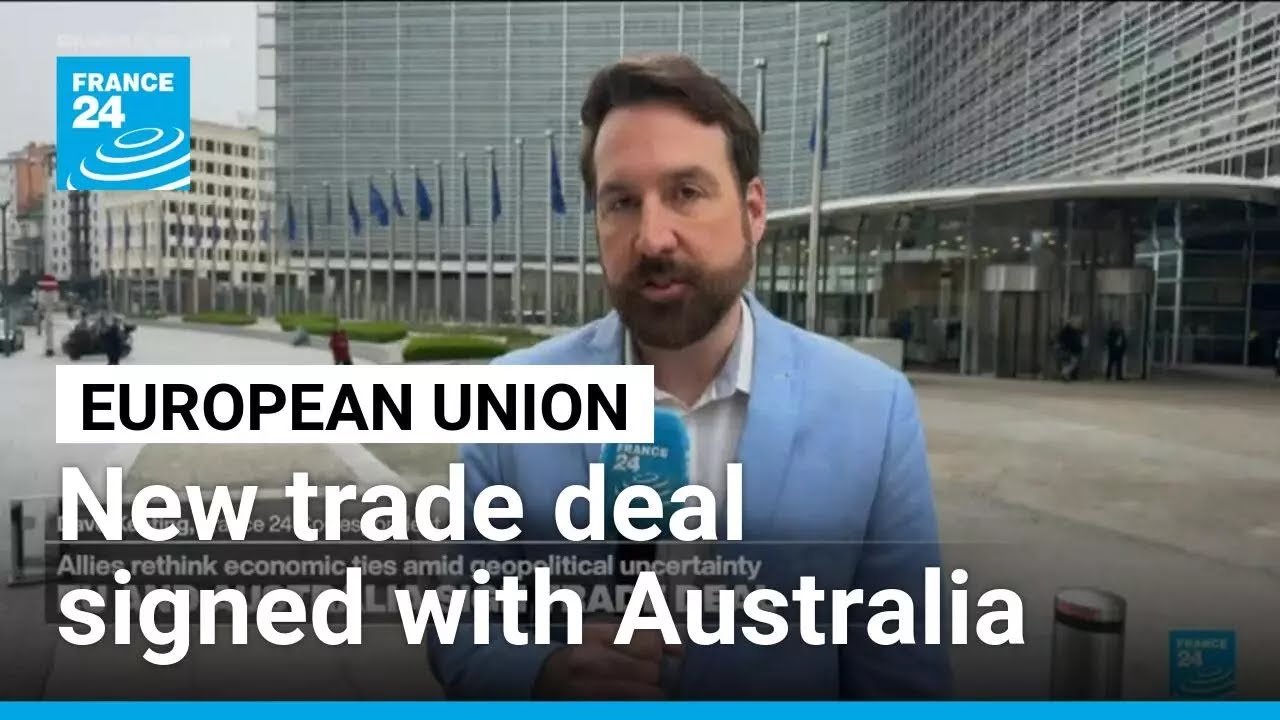
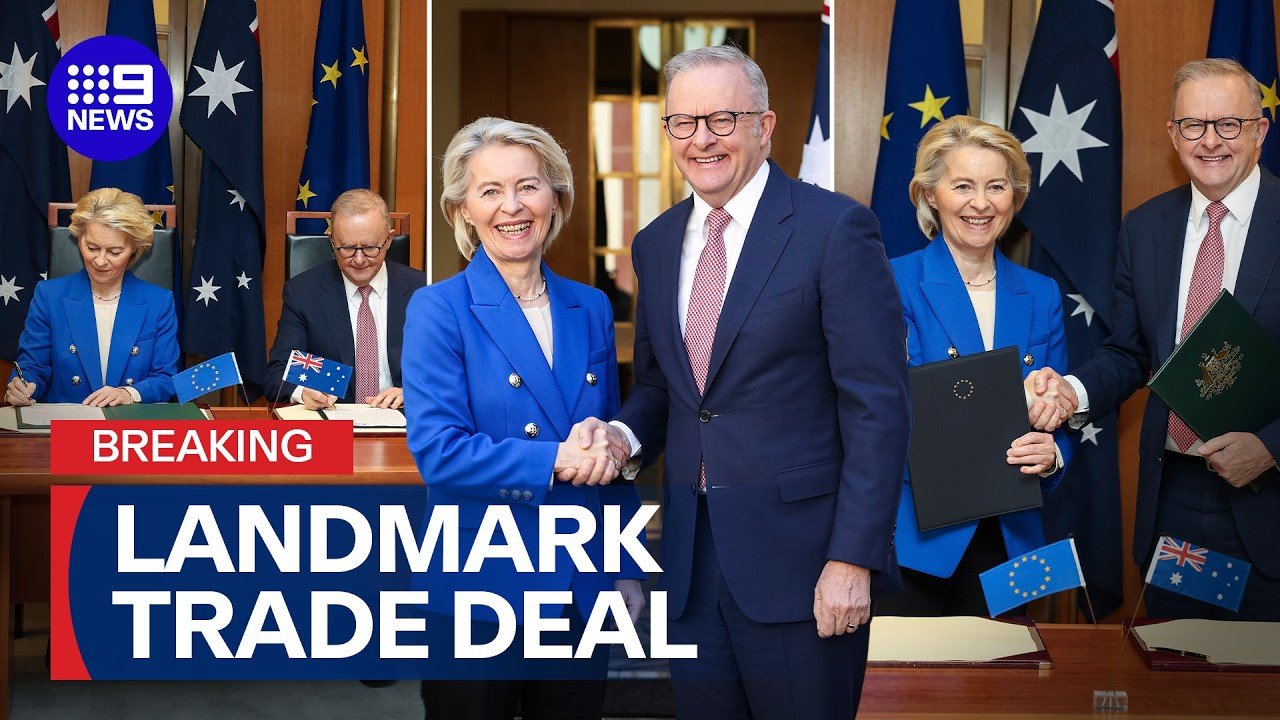
On March 24, 2026, Australia and the European Union concluded an eight‑year negotiation and signed a landmark Free Trade Agreement in Canberra, with Prime Minister Anthony Albanese and EU Commission President Ursula von der Leyen at the table.
The deal is set to remove over 99% of tariffs on EU goods entering Australia and 97.8% of tariffs on Australian exports to the bloc, significantly boosting bilateral trade valued at nearly $110 billion in 2024 to 2025.
Alongside the trade deal, the two sides signed a Security and Defence Partnership focused on cyber security, counter‑terrorism, and maritime security, tying the agreement to broader EU‑Australia strategic alignment and supply‑chain resilience.
What’s in the treaty?
Agriculture & Food
Australian farmers gain expanded access to the EU for beef, lamb, sugar, and dairy through new quotas. Tariffs will be eliminated on Australian wine, fruit, vegetables, honey, and seafood.
Australian winemakers can continue using the name “Prosecco” for domestic sales for 10 years, but must phase it out for exports. Popular terms like “Parmesan” and “Kransky” remain protected for Australian use.
However, major farming groups in Europe, led by the pan-European lobby Copa-Cogeca, have slammed the deal for granting what they call excessive concessions in “sensitive” sectors. The National Bovine Federation in France accused the Commission of “undermining” the beef industry, raising the possibility of renewed farmer protests across France similar to those seen during the Mercosur debates.
Farmers in Europe argue they are being used as a “bargaining chip” to secure the EU’s broader geopolitical goals, such as access to Australia’s critical minerals. The European Dairy Association (EDA) and Eucolait welcomed the deal, as EU dairy exports to Australia are projected to grow by up to 48%.
To calm domestic fears, the EU Commission included a “bilateral safeguard mechanism” that allows for the temporary re-imposition of tariffs if a sudden surge in Australian imports disrupts the market.
Critical Minerals
The pact secures EU access to Australia’s vast supplies of lithium, cobalt, and rare earth elements, which are essential for EV batteries and wind turbines. It reduces reliance on other suppliers like China. The EU currently relies on imports for 100% of its lithium and 96% of its manganese.
The agreement permanently eliminates almost all import tariffs on Australian critical minerals and manufactured resources entering the EU. Previously, some resources like hydrogen and its carriers faced fees up to 5.5%.
EU firms now have the right to invest in Australian mining and processing without discrimination, aiming to integrate the entire value chain from extraction to refining.
Australia is actively seeking billions in investment for 49 mining projects and 29 midstream processing projects. This deal complements Australia’s recent entry into the G7 Critical Minerals Production Alliance to further stabilize global supply.
In November 2025, the Australian government signed a declaration of intent with the European Investment Bank (EIB) to provide financial and advisory support for these critical minerals projects.
Automobiles & the Luxury Car Tax
The agreement creates a “fast lane” for European vehicles, which have long been hindered by multiple layers of taxation in Australia.
Australia will raise the LCT threshold to $120,000 specifically for zero-emission/electric vehicles. Previously, the threshold for fuel-efficient vehicles was $91,387 (2025–26).
This change is expected to exempt approximately 75% of EU-made EVs from the 33% luxury tax.
A separate 5% import tariff on all European passenger cars, including luxury brands like BMW, Mercedes-Benz, and Porsche, will be eliminated from day one.
Duties on trucks will not be removed immediately but will be phased out over a short transitional period.
Food, Spirits, and Household Goods
Tariffs will fall to zero for a wide range of iconic European products, potentially leading to lower shelf prices. These include chocolates, ice cream, sugar, various processed foods (like pasta and biscuits), spirits (such as Irish whiskey and Ouzo) and wines (including Champagne and Prosecco).
The removal of duties on machinery, chemicals, and pharmaceuticals is expected to reduce costs for Australian businesses, which may eventually flow down to consumers.
While many products see immediate relief, tariffs on European cheese will be gradually reduced to zero over a three-year period.
Talent bridge and work visas
The agreement creates a “bridge” between Australian and EU regulatory bodies for lawyers and accountants, engineers & architects and healthcare professionals.
The FTA introduces what’s technically called “Mode 4” entry, which focuses on the temporary movement of people for business. Big firms (like Macquarie or CSL) can move executives and specialists between their Australian and EU offices much more easily, with visas often granted for up to 3 years.
If an Australian company wins a contract in Germany, they can now send their staff there on guaranteed, streamlined visas for up to 12 months.
Self-employed experts in specific fields (like IT or management consulting) gain new legal rights to enter the EU for work projects.
While the FTA focuses on professionals, it also paved the way for side-agreements to expand Working Holiday Maker (WHM) programs.
Discussions are moving toward raising the age limit to 35 for more EU nations (matching the current deal with the UK) and new options to extend stays from one year to two or three years if working in specific sectors like regional development or “green” industries.
The deal makes it simpler for Aussie tech startups to set up shop in EU hubs like Berlin or Tallinn, offering “landing pad” visas that bypass some of the usual capital requirements for foreign businesses.
While the EU sets the broad rules, individual countries (like France or Italy) still have some say over their local labor markets.
Does this take effect straight away?
The agreement has been signed, but it is not yet “active”.
The European Council must adopt the proposal, followed by the European Parliament’s consent. The Australian Parliament must pass the necessary legislation to implement the deal.
Read also:
2026 EU-India Free Trade Agreement