





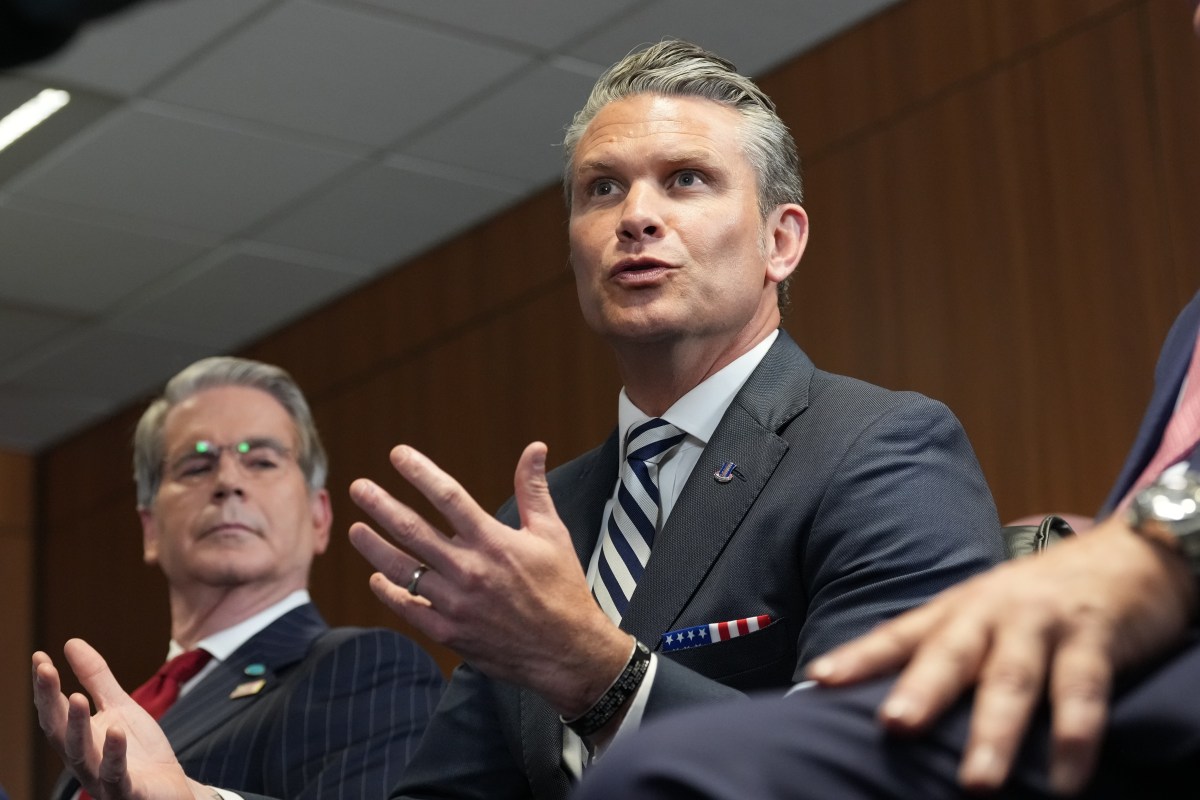

Defense Secretary Pete Hegseth has ordered mandatory annual testosterone deficiency screenings for all US service members aged 30 and older, framing the “High-T” initiative as essential for maintaining combat readiness and long-term troop health.
The screening requirement takes effect immediately and will be integrated into the existing Periodic Health Assessment (PHA) that all active-duty and reserve personnel complete annually. Service members under 30 may request the test voluntarily, though it is not required for their age group.
If testing reveals a testosterone deficiency, undergoing Testosterone Replacement Therapy (TRT) remains entirely optional for the individual service member. Hegseth emphasized in a video announcement posted to X that the program is “not about artificial enhancement” but rather about “restoring and optimizing your natural capabilities, protecting your longevity and ensuring you have the biological foundation required to sustain the fight”.
The High-T Department of War. pic.twitter.com/hlAUq3j2cD
— Secretary of War Pete Hegseth (@SecWar) July 15, 2026
The Defense Secretary branded the initiative under the moniker “The High-T Department of War,” stating that maintaining proper testosterone levels would keep troops on the “leading edge of lethality.” However, the Pentagon has not disclosed what specific research or academic studies informed the policy decision, nor has it clarified how testosterone deficiency will be defined for female service members, who naturally produce the hormone at significantly lower concentrations than men.
Medical community pushback
Major medical organizations have criticized the mandate, arguing it contradicts established clinical guidelines. The Endocrine Society, which publishes authoritative standards on testosterone therapy, stated that hormone treatment is appropriate only for men with diagnosed hypogonadism confirmed through repeated laboratory testing — not for blanket screening of asymptomatic populations.
A spokesperson for the Endocrine Society warned that prescribing testosterone to raise performance in men with normal levels lacks evidentiary support and could increase cardiovascular and fertility risks. The American Urological Association similarly noted that the FDA requires labelling warnings against using testosterone for age-related decline or performance enhancement purposes.
Medical experts highlighted several practical challenges with the policy. Testosterone levels fluctuate throughout the day, and accurate readings typically require morning blood draws after fasting—conditions that may be difficult to standardize across diverse military installations worldwide. Critics also raised concerns about potential pressure on service members to accept treatment despite the voluntary designation, given the policy’s framing around operational readiness.
Political and cultural controversy
Democratic lawmakers have condemned the move as an ideological “culture-war” policy, pointing to what they describe as a stark contradiction in the administration’s approach to hormone therapy. While the Pentagon is now funding testosterone treatment for cisgender troops identified with deficiencies, the Trump administration simultaneously maintains a ban on transgender service members who require gender-affirming hormone care.
The Justice Department filed paperwork on July 16, 2026, indicating it would petition the Supreme Court to uphold the transgender service ban, which Pentagon chief Hegseth officially reinstated in February 2025 as part of his broader effort to eliminate what he terms “woke” policies within the military.
Critics argue this creates an untenable positions: hormone therapy is deemed essential for combat readiness when prescribed to cisgender men, yet disqualifying for transgender individuals serving under the same armed forces.
Context and unanswered questions
Several key details about the policy remain unclear. The Pentagon has not specified the cost implications for the Defense Health Agency, nor has it outlined how the program will be administered across overseas bases with varying medical infrastructure.
Additionally, officials have not addressed whether female troops experiencing perimenopause or other hormone-related conditions would be eligible for parallel estrogen-based screening or therapy.
The policy aligns with Hegseth’s broader push to establish a “warrior ethos” emphasizing physical standards and readiness throughout the military, but medical professionals question whether the evidence base supports mass screening as an effective readiness tool.