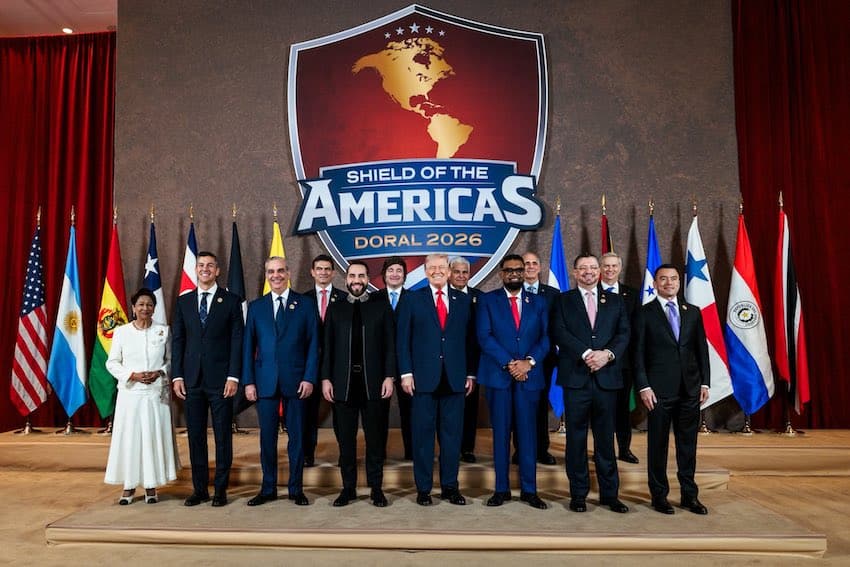
The Shield of the Americas Summit was an inaugural diplomatic and security gathering held on March 7, 2026, at the Trump National Doral Miami resort in Florida.
The summit focused on promoting “freedom, security, and prosperity” by addressing foreign interference, narco-terrorism, and mass immigration.
The key objective was to establish a “Shield of the Americas” through a multinational military cooperation initiative aimed at eradicating drug cartels and terrorist networks. The Summit centered on a pivot toward “hard power” and military intervention to secure the Western Hemisphere.
The Americas Counter-Cartel Coalition is a regional partnership designed to leverage military and intelligence assets to combat transnational criminal organizations.
The initiative is part of a broader foreign policy strategy often referred to as the “Donroe Doctrine” (or a “Trump Corollary” to the Monroe Doctrine) to reassert US leadership and counter Chinese and Russian influence in the Western Hemisphere.
The summit brought together leaders from 13 nations, featuring key figures such as Javier Milei (Argentina), Nayib Bukele (El Salvador), Santiago Peña (Paraguay), and Daniel Noboa (Ecuador). Additional member states involved included several from Central and South America.
Key US officials attending included Secretary of State Marco Rubio, Defense Secretary Pete Hegseth, and Treasury Secretary Scott Bessent.
President Trump appointed Kristi Noem as the inaugural Special Envoy for the initiative.
Establishment of the Americas Counter-Cartel Coalition (ACCC)
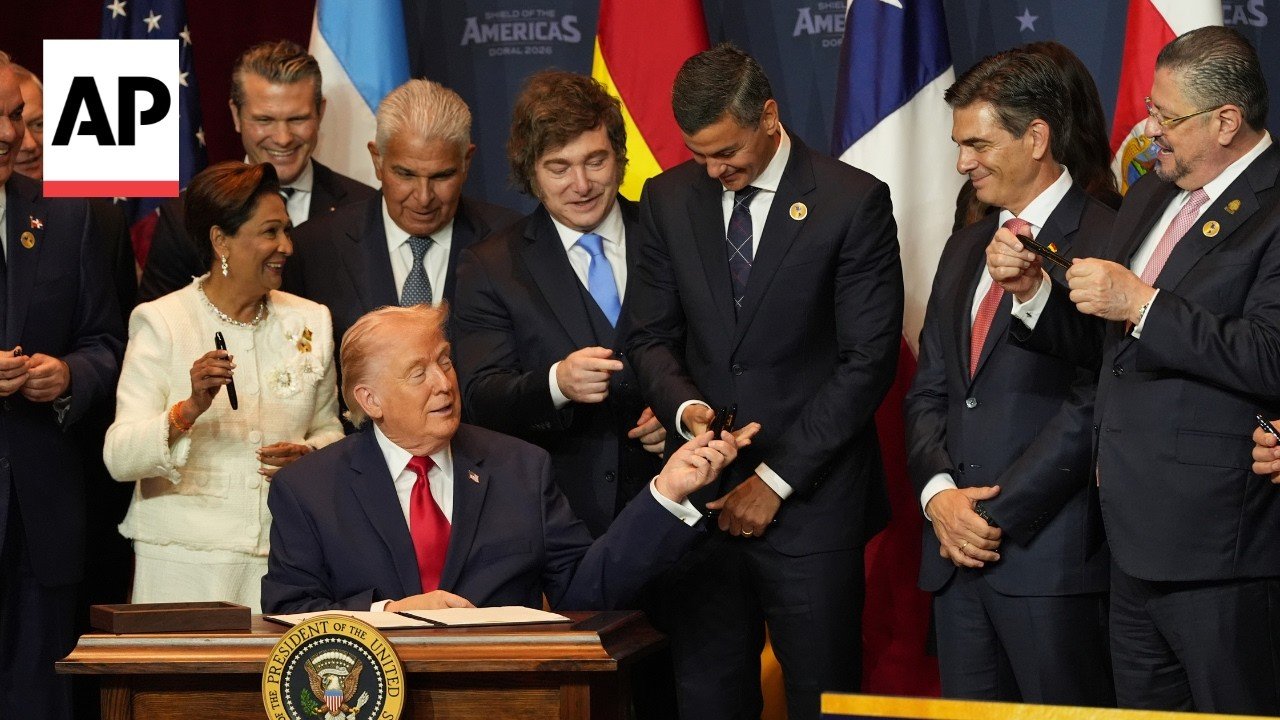
President Trump formally launched a 17-nation alliance committed to using lethal military force against transnational criminal organizations.
The coalition focuses on intelligence sharing, joint military operations, and “offensive actions” to dismantle drug networks. Trump proposed using US missile strikes to target cartel leaders and assets within the region.
The full list of 17 nations who signed the ACCC: United States, Bahamas, Argentina, Belize, Bolivia, Guatemala, Chile, Jamaica, Costa Rica, Peru, Dominican Republic, Ecuador, El Salvador, Guyana, Honduras, Panama, Paraguay and Trinidad and Tobago.
Regional security and sovereignty
Discussions emphasized a shared commitment to border security and the elimination of narco-terrorist groups.
Leaders discussed the “Donroe Doctrine” (or a modern take on the Monroe Doctrine), aimed at reasserting US dominance and countering foreign influence from countries like China, Russia, and Iran.
Trump highlighted the recent US military operation to capture former Venezuelan president Nicolás Maduro as a model for future regional security actions.
Trump explicitly stated that Cuba is “in its last moments of life,” suggesting his administration would soon turn its attention toward ending communist leadership on the island.
Economic prosperity and migration
The summit linked regional stability to economic growth and “free commerce”, arguing that dismantling cartels is a prerequisite for prosperity.
Addressing mass illegal immigration was framed as a national security priority that requires collective action from all coalition members.
Reactions from absent nations
The three largest economies in Latin America, Mexico, Brazil, and Colombia, were pointedly absent, representing a significant gap in the coalition’s reach.
Mexico’s President Claudia Sheinbaum reaffirmed that Mexico will not permit US troops or military operations on its soil, stating “proudly we continue to say no”. She argued the US could best help by stopping the flow of American weapons into Mexico (estimated at 75% of cartel arsenals) and reducing domestic drug consumption.
Brazil’s President Luiz Inácio Lula da Silva maintained “strategic autonomy,” continuing deep trade ties with China while avoiding participation in what critics called a “neocolonial” military alliance.
Colombia’s President Gustavo Petro remained absent, despite a brief improvement in relations following the US raid in Venezuela, reflecting broader leftist skepticism toward US military interventionism.
Cuba’s President Miguel Díaz-Canel condemned the summit as “small, reactionary, and neocolonial,” accusing the US of coercing right-wing governments into accepting foreign military force to resolve internal domestic issues.
Haiti was not invited to the Shield of the Americas Summit. The Haitian Times wrote that the country’s leaders are seeking international support with its worsening crisis through Washington lobbyists but was excluded from the meeting alongside other regional allies.
Read also:
US and Ecuador launch joint operation to combat narco-terrorism
Druglord El Mencho killed by Mexican Special Forces
US Special Forces captures Nicolás Maduro