

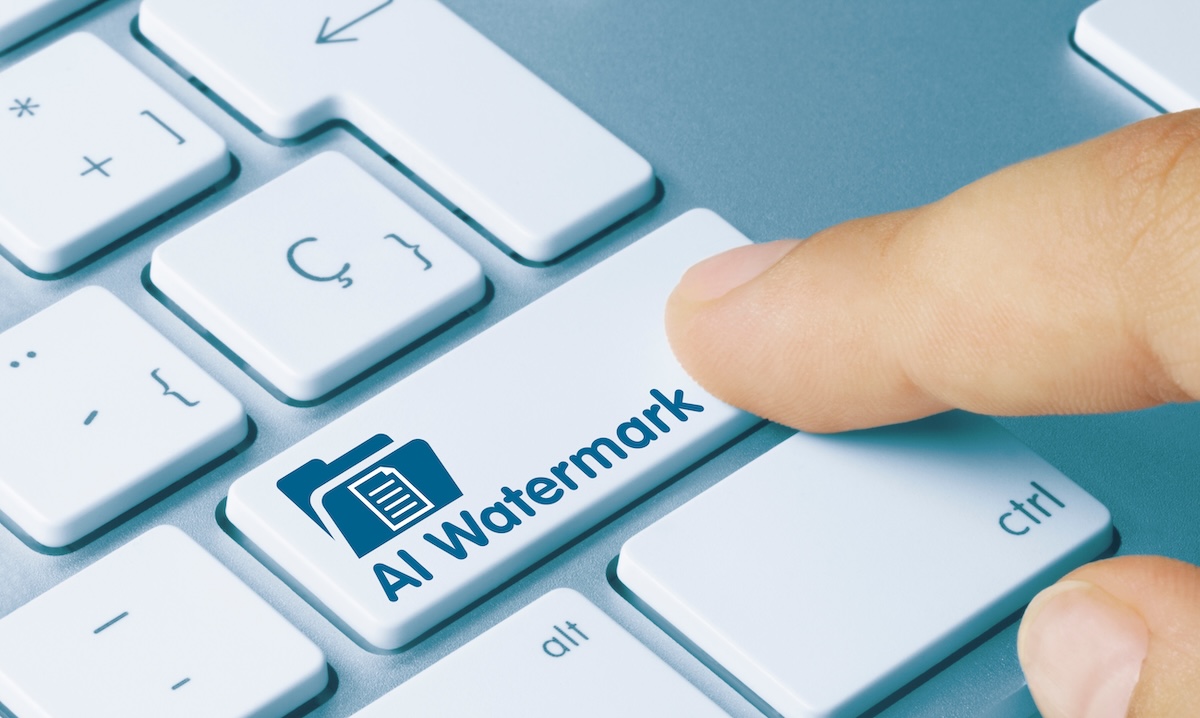
Anthropic is introducing machine-readable markers for content generated or processed by its Claude artificial-intelligence models, including an invisible watermark for text and signed provenance metadata for supported files.
The move follows Anthropic’s decision to sign the European Union’s Code of Practice on Transparency of AI-Generated Content, a voluntary compliance framework linked to Article 50(2) of the EU AI Act. Although the legal obligations originate in Europe, Anthropic says the marking system will apply globally wherever supported Claude models are available.
The company’s policy covers Claude’s consumer service, its developer API, Claude Code, Claude Cowork and Claude Tag. Marking will also apply when supported Claude models are accessed through cloud providers including Amazon Web Services, Google Cloud and Microsoft Foundry, although particular file-marking features may vary by platform.
Anthropic has long advocated for transparency requirements for frontier AI, because the risks weren't yet clear enough to regulate precisely. That is no longer sufficient.
— Dario Amodei (@DarioAmodei) June 10, 2026
What the EU rules require
Article 50(2) requires providers of generative AI systems to ensure that machine-generated or manipulated outputs are marked in a format that other systems can detect. The obligation covers synthetic text, audio, images and video, with the technical measures expected to be effective, interoperable, robust and reliable as far as technically feasible.
The broader Article 50 transparency rules also address situations in which people interact directly with AI systems, deepfakes and certain AI-generated or manipulated text published on matters of public interest.
The European Commission says the Code of Practice does not replace the AI Act. Instead, it provides a recognised method for providers and deployers to demonstrate compliance. Companies that do not follow the code may use alternative measures, but they may need to prove separately to market-surveillance authorities that those measures are adequate.
The transparency obligations began applying on August 2, 2026. However, generative AI systems placed on the market before that date have a limited transition period for the Article 50(2) marking requirement, lasting until December 2, 2026. New systems introduced after August 2 are expected to support marking from launch.
Failure to comply with the AI Act’s transparency rules can result in penalties of up to €15 million or 3% of a company’s total worldwide annual turnover, subject to the applicable enforcement framework and proportionality rules.
How Claude’s text watermark works
For text, Anthropic says Claude will weave an imperceptible, machine-readable watermark directly into its output. The mark is designed not to alter the response’s meaning, quality or readability.
Because the signal is embedded in the text rather than displayed as a visible label, it can travel when users copy and paste the material into another document, website or publishing system. Anthropic also says it may survive some editing, although the company has not yet published full technical documentation explaining the detection process or specifying how much alteration a watermark can withstand.
The watermark is applied at the model level. In principle, that means the marking does not depend solely on whether a user accesses Claude through the consumer app, an API integration or one of Anthropic’s coding and workplace tools.
Anthropic says it intends to provide detection support to users and third parties, but publicly available details about how people will scan text for the watermark remain limited. The company’s help documentation says further technical guidance will be released.
Files will carry provenance metadata
Claude-generated files use a different system. When a supported file type is created or processed, Anthropic may attach digitally signed provenance metadata based on the Coalition for Content Provenance and Authenticity, or C2PA, standard.
The approach is closer to a cryptographically verifiable record than to an invisible text watermark. A valid C2PA credential can indicate that a file was processed by Claude and can help determine whether the associated provenance record has been altered. Anthropic lists formats such as SVG, PNG and JPEG among the supported file types, while warning that availability depends on the platform and feature involved.
The metadata is not indestructible. It may disappear when a file is converted, resaved, screenshotted or passed through software that does not preserve provenance information. A screenshot of an AI-generated image, for example, may no longer contain the original file’s signed metadata.
That distinction matters: the absence of C2PA data does not demonstrate that an image or document was created by a person.
Older models are being updated
Claude models launched in the European Union on or after August 2, 2026, are intended to support machine-readable marking at launch. Anthropic says it is also working to add marking capabilities to models released before that date during the transition period.
This means users should not assume that every historical Claude response already contains a detectable mark. Older model versions, legacy API workflows and unsupported file types may produce output without the new system.
Anthropic’s announcement also does not mean that every Claude-generated file will receive every type of marking on every platform. Text watermarking is described as applying to supported models, while signed provenance metadata depends on file handling and the capabilities offered by the relevant cloud or software platform.
A watermark is not proof of authorship
Anthropic has cautioned that a detected mark should be treated as evidence that content may have been processed by Claude—not conclusive proof that Claude originally authored all of it.
For example, a user could submit a human-written essay to Claude for proofreading, translation, summarisation or formatting. The resulting version may carry a Claude mark even though the underlying ideas and wording originated with a person.
The reverse problem also applies. A genuine Claude response may become undetectable after extensive editing, paraphrasing, translation or combination with other material. Very short passages may not contain enough text for reliable detection, and file metadata can be removed through routine editing or conversion.
The system therefore works as a provenance signal rather than a definitive authorship test. Schools, publishers, employers and fact-checkers that use it will still need to consider the content’s editing history, source material and other evidence.
Implications for developers and publishers
Anthropic’s global rollout could affect websites and applications that use Claude through an API. A developer who sends Claude’s output directly to users may receive text containing the embedded mark, even if the end user never interacts with Claude’s interface.
Anthropic says developers deploying Claude in their own products should independently assess what Article 50 requires of their services. The company plans to publish technical guidance to help developers understand the marking and detection approach, but responsibility for downstream disclosure may not disappear simply because the underlying model includes a machine-readable signal.
This is especially relevant to news aggregators, publishing platforms and automated content pipelines. A hidden mark may help a verification system identify that text passed through Claude, but it will not necessarily tell readers that an article was AI-assisted. Depending on the use case, a publisher may still need a visible disclosure or editorial explanation.
The EU’s Code of Practice distinguishes between provider obligations—marking and enabling detection—and deployer obligations, such as labelling certain deepfakes or AI-generated text publications concerning matters of public interest. Text published on such subjects may be exempt from the specific labelling requirement where it has undergone human review and remains subject to editorial responsibility, but the exact application depends on the circumstances.
The wider industry shift
Anthropic’s announcement is part of a broader effort by technology companies to establish technical provenance systems for synthetic media. The EU code promotes a layered approach involving signed metadata, imperceptible watermarking and, where appropriate, additional detection, fingerprinting or logging mechanisms rather than relying on a single method.
That approach reflects a practical limitation: no current marker is guaranteed to survive every form of editing, conversion or redistribution. Metadata can be stripped, text can be rewritten and content can move between systems that do not preserve provenance information.
Claude’s new marking system may nevertheless give platforms an additional way to identify AI involvement—particularly when output is copied with only minor changes or when original files retain their C2PA credentials. For users and publishers, the central message is more limited than “AI content can now be exposed”: Claude output may carry a detectable signal, but that signal will need to be interpreted alongside human review and a record of how the content was created.