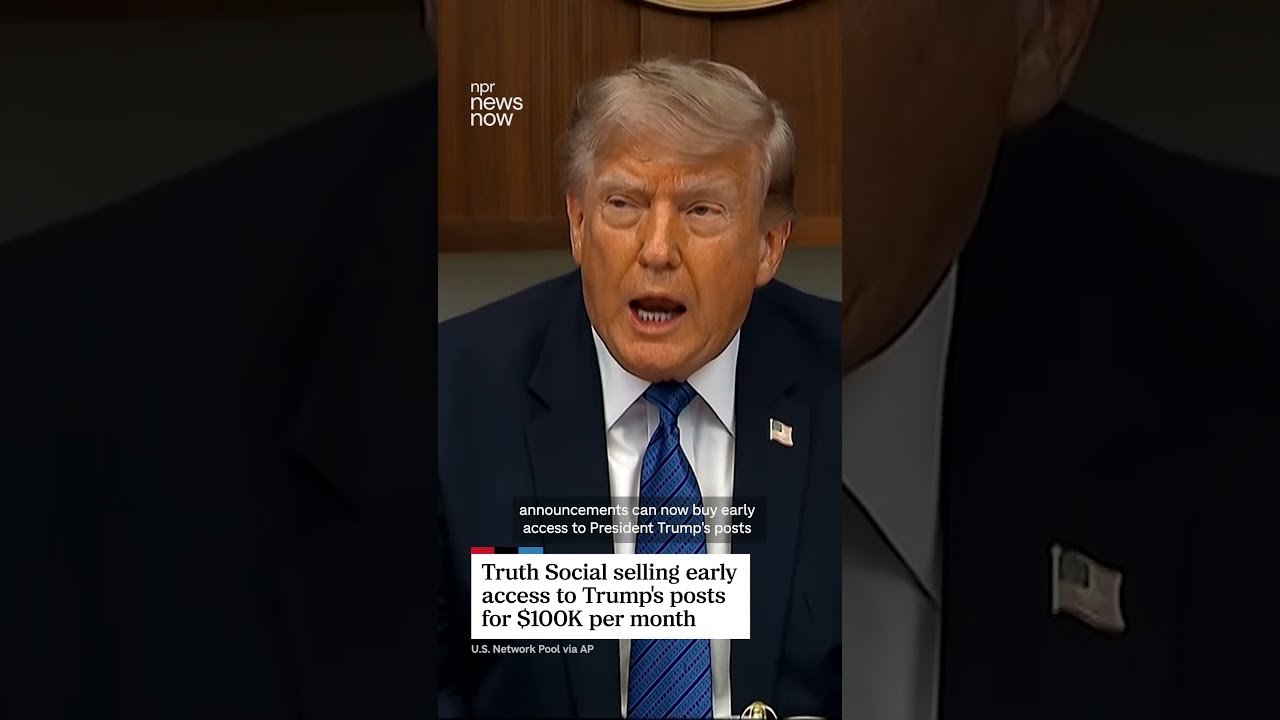




Trump Media & Technology Group (TMTG) has officially begun selling ultra‑low‑latency access to posts on Truth Social, including those by President Donald Trump, through a new product called Truth API that went live on August 1, 2026.
The service is pitched as a licensed data feed for Wall Street firms and high‑frequency traders, but ethics watchdogs and lawmakers warn it effectively monetizes privileged, market‑moving information from a sitting president.
What Truth API sells — and to whom
Truth API is a business‑to‑business data product that delivers posts from Truth Social’s 10 most influential accounts to institutional clients in milliseconds before those posts appear in the standard public feed. TMTG interim CEO Kevin McGurn has described it as a “direct, licensed, real‑time feed of the platform’s most market‑moving Truths,” aimed at algorithmic and automated trading operations where tiny speed advantages can translate into large profits.
While TMTG has not always explicitly named Trump in its marketing, his account is by far the largest on the platform — with nearly 13 million followers — and is understood to be among the top accounts covered by the feed. Other high‑ranking accounts reportedly include those of his sons and prominent media allies, though the company has not published a definitive list.
Pricing has been reported at up to $100,000 per month (about $1.2million annually), with a discounted rate of roughly $60,000 per month for firms that commit to a three‑year contract. TMTG says it had already signed up customers ahead of the August 1 launch, including financial news organizations and high‑frequency trading firms.
TMTG’s defense: “public information,” standard practice, and anti‑scraping
TMTG and its spokespeople have pushed back hard against accusations of wrongdoing, casting the product as a normal, lawful data‑licensing business.
- All information is public: TMTG spokesperson Shannon Devine has argued that critics are inventing a “new theory of ‘insider trading’ based on publicly available information”, stressing that posts are not shared in advance behind closed doors but are instead distributed to all users at the same moment — with paying clients simply able to ingest them faster.
- Industry precedent: The company points to long‑standing practices by other platforms and data vendors — including X (formerly Twitter), Bloomberg, and major exchanges — that sell structured, low‑latency data feeds to institutional clients. From TMTG’s perspective, Truth API is just another licensed data product built on a proprietary digital asset.
- Curbing unregulated scraping: McGurn has said that before Truth API, Wall Street firms were already building bots to scrape Trump’s public profile manually. The company positions its feed as a secure, regulated alternative that “closes the gap” and brings order to how businesses interact with Truth Social data.
Why Wall Street cares: speed, policy, and profit
For high‑frequency trading (HFT) firms and quantitative hedge funds, milliseconds matter. A delay of even a few thousandths of a second can determine whether an algorithm buys or sells ahead of a market move, locking in profits or avoiding losses on large positions.
Trump’s posts have repeatedly moved markets in his first term and early in his second, with announcements on tariffs, trade deals, sanctions, foreign conflicts, and regulatory shifts triggering sharp swings in equities, bonds, and currencies. By paying for Truth API, institutions gain a structured, low‑latency channel to ingest those posts and route trades faster than competitors relying on the public interface or unofficial scrapers.
Some traders have told reporters they feel they have “no choice” but to subscribe, fearing that if rivals buy the feed and they do not, they will be systematically disadvantaged whenever a Trump post hits.
Financial ties: a president profiting from his own platform
TMTG frames Truth API as a new, high‑margin revenue stream for a company that has struggled to show consistent profits. McGurn has said the product is intended to “monetize proprietary assets” and create a “steady, meaningful source of ongoing revenue”.
President Trump owns about a 41% stake in TMTG through a revocable trust managed by his family, meaning subscription revenues flow directly into an enterprise that substantially benefits his personal net worth. Critics argue this creates a direct financial incentive for the president to use his official communications in ways that boost engagement — and, by extension, the value of the data feed.
Insider‑trading and market‑manipulation concerns
The core ethical and legal question is whether selling faster access to a sitting president’s posts amounts to selling material non‑public information (MNPI) — the kind of data that securities laws are designed to protect against misuse.
- Legal experts’ view: Some former SEC officials and securities law professors say the arrangement appears to conflict with federal insider‑trading prohibitions. They argue that if the president’s posts contain policy or corporate information that is not yet broadly disseminated, then giving select clients earlier access may constitute “misappropriated information” and breach a duty of trust and confidence owed to the public.
- Watchdog warnings: Groups focused on government ethics and market integrity warn that the service could normalize a form of insider trading tied to official government communications, eroding investor confidence.
- Congressional pressure: Democratic lawmakers have formally asked the SEC to investigate. Rep. Ritchie Torres (D‑N.Y.) sent a letter to SEC Chair Paul Atkins urging a review of whether Truth API raises securities‑law, market‑manipulation, or investor‑protection concerns. Senators Elizabeth Warren and Adam Schiff have also pressed for regulatory scrutiny, though specific letters and timelines have varied by outlet.
TMTG has also accused critics of political motivation, suggesting that opposition stems from ideological hostility to free markets or a misunderstanding of the distinction between public and nonpublic information.
White House distance — and the unresolved ethics question
The White House has maintained a clear separation between the presidency and TMTG’s commercial operations. When pressed on Truth API, officials have referred questions to the company, emphasizing that the product is run by a private business and that Trump’s stake is held in a family trust.
That formal distance does little to assuage critics, who argue that a president’s social media posts are effectively official communications when they signal policy, and that monetizing faster access to them blurs the line between public duty and private profit.