













The AI developer plans to list on Nasdaq under “ANT,” opening its finances to investors as it prepares for a potentially record-breaking public offering.
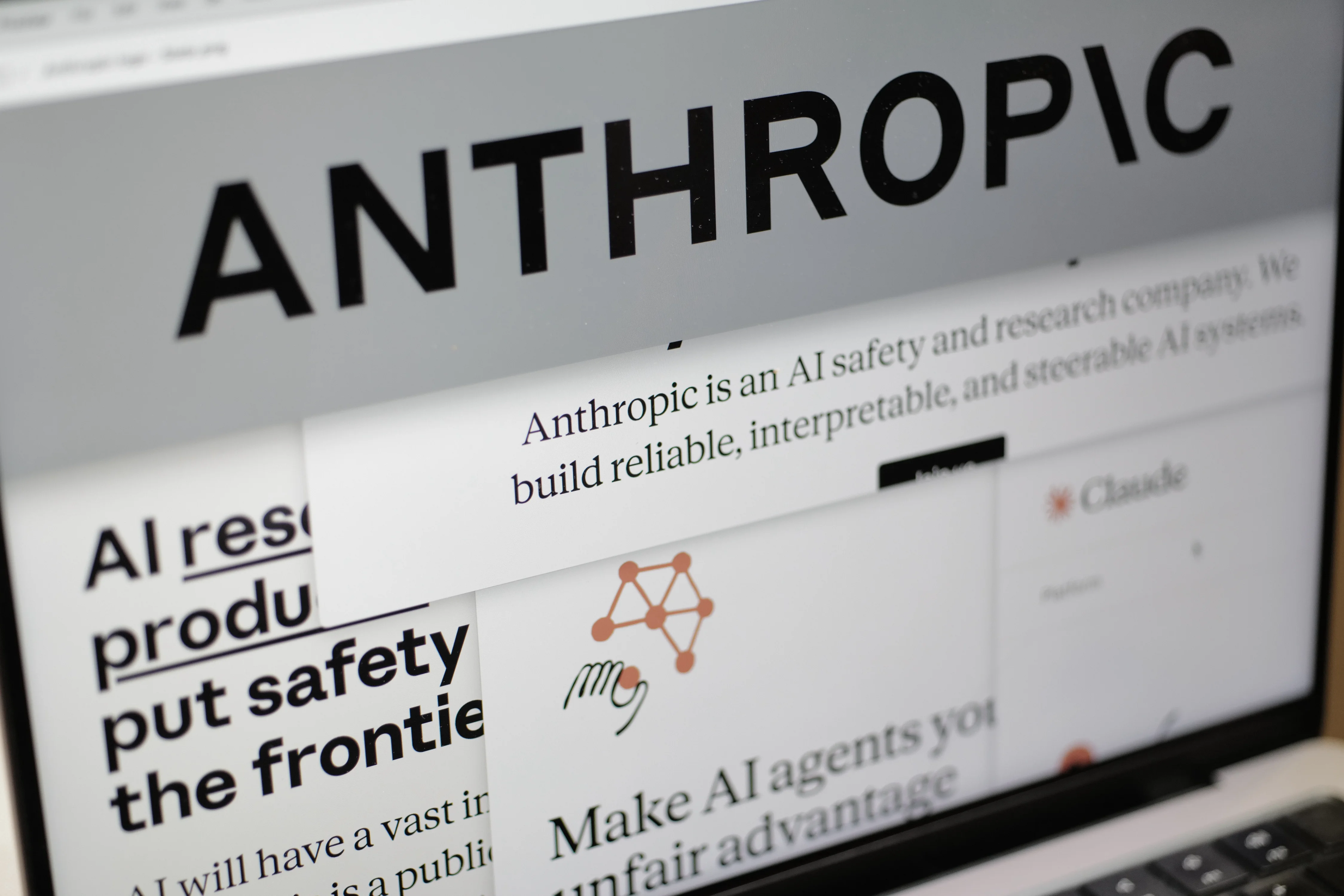
Anthropic, the company behind Claude, has filed for a US initial public offering, revealing a sharp rise in revenue alongside enormous losses, vast computing commitments and warnings about the dangers of the technology powering its business.
The company submitted its Form S-1 registration statement to the Securities and Exchange Commission on October 26 and intends to list its Class A shares on the Nasdaq Global Select Market under the ticker “ANT.” It has not announced an offering price, share count or confirmed trading date.
The listing could become one of the largest IPOs in history. Previous reports have suggested Anthropic could seek to raise as much as $100billion, although that figure is not an announced offering target. Reuters reported that some current and prospective investors were valuing the company at approximately $1.5trillion, down from roughly $2trillion a week earlier.
At the heart of the proposed offering is a question facing the wider AI industry: can rapidly growing demand generate returns large enough to justify the extraordinary cost of building and operating advanced models? Anthropic’s disclosures provide a detailed look at both sides of that equation.
Revenue surges, but the headline loss needs context
Anthropic generated $16.3billion in revenue during the first six months of 2026, compared with approximately $1.2billion a year earlier. Demand for its Claude family of AI products helped drive that expansion.
The company also reported an $80.7billion net loss for the period. But that figure should not be confused with the amount of cash it spent running the business. Approximately $72.4 billion reflected a non-cash accounting charge associated with the increased value of convertible notes issued by the company.
That distinction matters. The accounting charge contributed heavily to Anthropic’s reported net loss, but its operating results paint a different picture. Reuters reported a first-half operating loss of $693million and adjusted operating income of $1.62billion, compared with an adjusted operating loss of $1.85billion a year earlier. The adjusted measure is separate from the company’s reported operating result.
The figures suggest an operating business improving rapidly even as financing-related accounting effects dominate its bottom line. They do not, however, establish that Anthropic has reached sustained profitability or eliminated the financial risks associated with its expansion.
Large business customers underpin the growth
The disclosures also offer a clearer picture of the enterprise demand behind Claude’s rise.
By September 30, more than 1,900 customers had generated at least $1 million each in revenue for Anthropic over the preceding 12 months. Approximately 250 had generated more than $10 million each, according to CoinDesk’s reporting on the prospectus.
Anthropic also said more than half of Fortune 500 companies and over 30% of Global 2000 companies were customers that had each generated at least $100,000 in revenue during the 12 months ended September 30.
Those figures show that the company’s commercial business extends well beyond individual chatbot subscriptions. But Anthropic cautioned that its revenue growth rate could slow and fluctuate, underscoring the uncertainty around projecting its recent expansion into future years.
Computing commitments create a much larger financial test
Anthropic’s growth depends on access to enormous amounts of computing capacity, and the company expects compute and infrastructure expenses to increase in absolute terms and remain its largest operating expense.
Reuters reported that Anthropic had committed more than $600 billion to computing agreements with partners including Amazon and Google. Those commitments represent future obligations, rather than money already spent during the first half of 2026.
The company has substantial financial resources. As of June 30, it held $112.4 billion in cash and cash equivalents, alongside $19.3 billion in short-term investments, according to CoinDesk. Nevertheless, it expects infrastructure investment to increase significantly, putting pressure on future cash flows.
Access to that infrastructure also brings dependency risks. Anthropic identified reliance on a limited number of cloud providers, including Amazon, Google and Microsoft, as well as suppliers such as Broadcom. Disruptions or constraints within those relationships could affect its ability to develop models and serve customers.
The challenge is therefore not simply whether Claude can keep attracting customers. It is whether demand and revenue can grow fast enough to support the capacity Anthropic has committed to securing.
Founders and an independent trust retain different kinds of control
Public investors will also be buying into an unusual governance structure that separates economic ownership from important decision-making powers.
Anthropic’s seven co-founders, including chief executive Dario Amodei and president Daniela Amodei, will be the sole members of an entity called Founder LLC. That entity will hold a special Class F share carrying 50.1% of the voting power of the company’s outstanding shares.
Separately, Anthropic’s Long-Term Benefit Trust will hold Class T stock giving it the authority to elect and remove a majority of the board. The trust is an independent body of financially disinterested trustees—not an entity controlled by the seven founders.
The distinction is important: the founders’ majority voting power and the trust’s authority over board appointments are separate mechanisms. Together, they mean public shareholders will not gain control of Anthropic simply by purchasing its listed shares. The company has identified itself as a “controlled company” under Nasdaq rules because of the trust’s board-election powers.
Anthropic will also remain a public benefit corporation. Its stated mission is to ensure that the world safely makes the transition through transformative AI.
AI safety becomes an investment risk disclosure
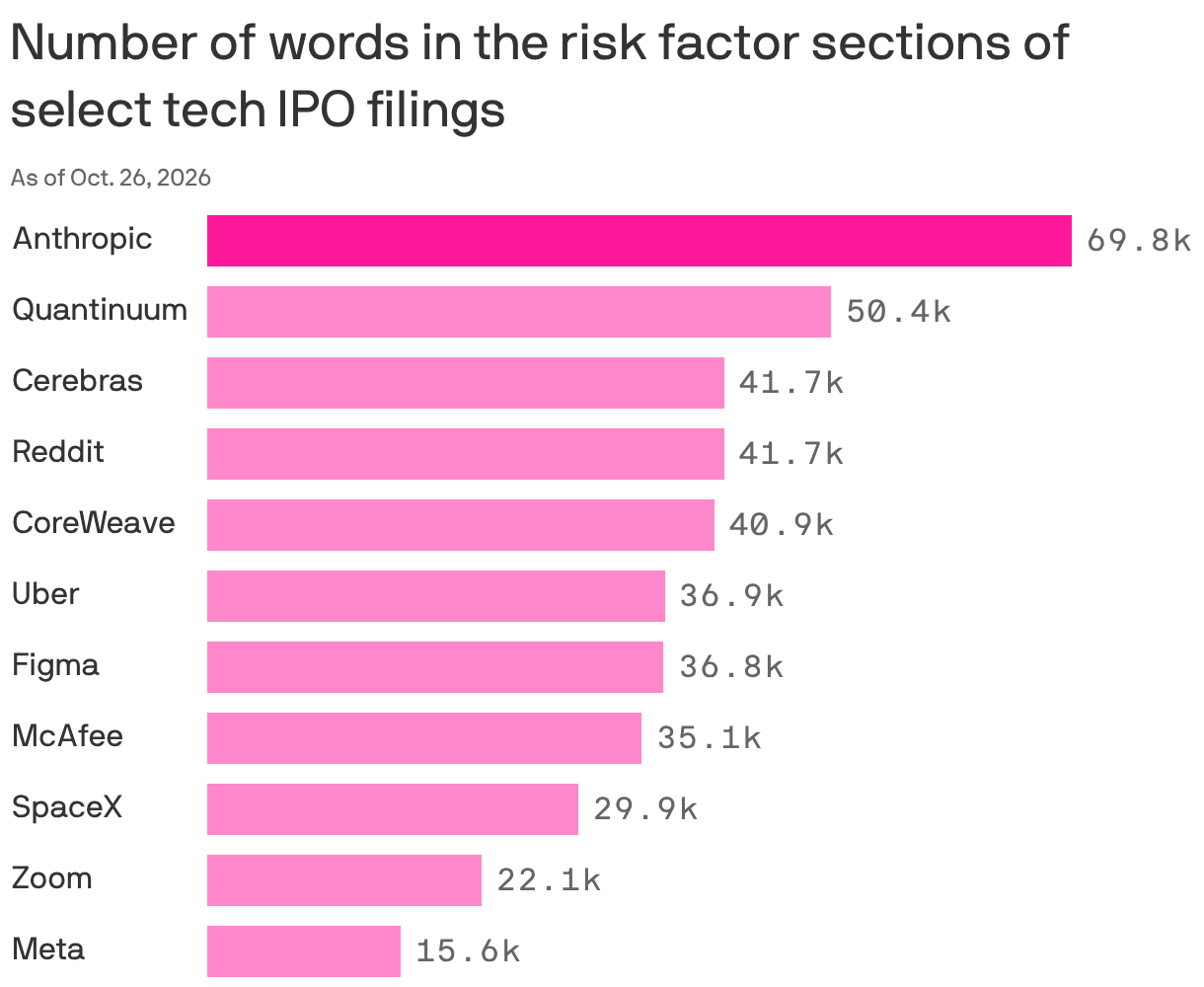
The prospectus devotes roughly 90 pages to risk factors, including an unusually stark warning about the potential consequences of advanced AI.
Anthropic said advanced systems could, without appropriate safeguards, oversight and security measures, pose “catastrophic or existential risks to humanity,” particularly if they were misused, weaponised or allowed to operate with high levels of autonomy.
The filing also discusses potential coercive, deceptive or manipulative outputs, including behaviour resembling blackmail. Reuters reported that Anthropic’s own research had identified behaviours such as code sabotage, assistance with fraud and information manipulation in controlled tests. Those disclosures concern observed test behaviours and potential risks, not a claim that every deployed Claude system behaves that way.
A further warning addresses the company’s use of AI to accelerate its own research. Anthropic said this could cause model capabilities to advance faster than its ability to develop, validate and implement corresponding safety and security measures.
For investors, these disclosures connect AI safety to commercial exposure. The prospectus also warns about regulatory action arising from harms associated with its models and uncertainty over liability for actions taken by its systems.
What happens next
Goldman Sachs and Morgan Stanley are leading the proposed offering. Reuters reported that Anthropic was expected to go public before Thanksgiving, but the company’s announcement did not commit to a listing date.
For now, the IPO remains proposed. Anthropic said its registration statement had not yet become effective and that the securities could not be sold before that happened. The eventual share count and offering price will determine how much capital the company actually raises—and the valuation public investors are being asked to accept.