President Donald Trump announced the launch of Stargate on January 21, 2025, a $500billion private-sector initiative aimed at building the physical and virtual infrastructure required for next-generation artificial intelligence in the United States.
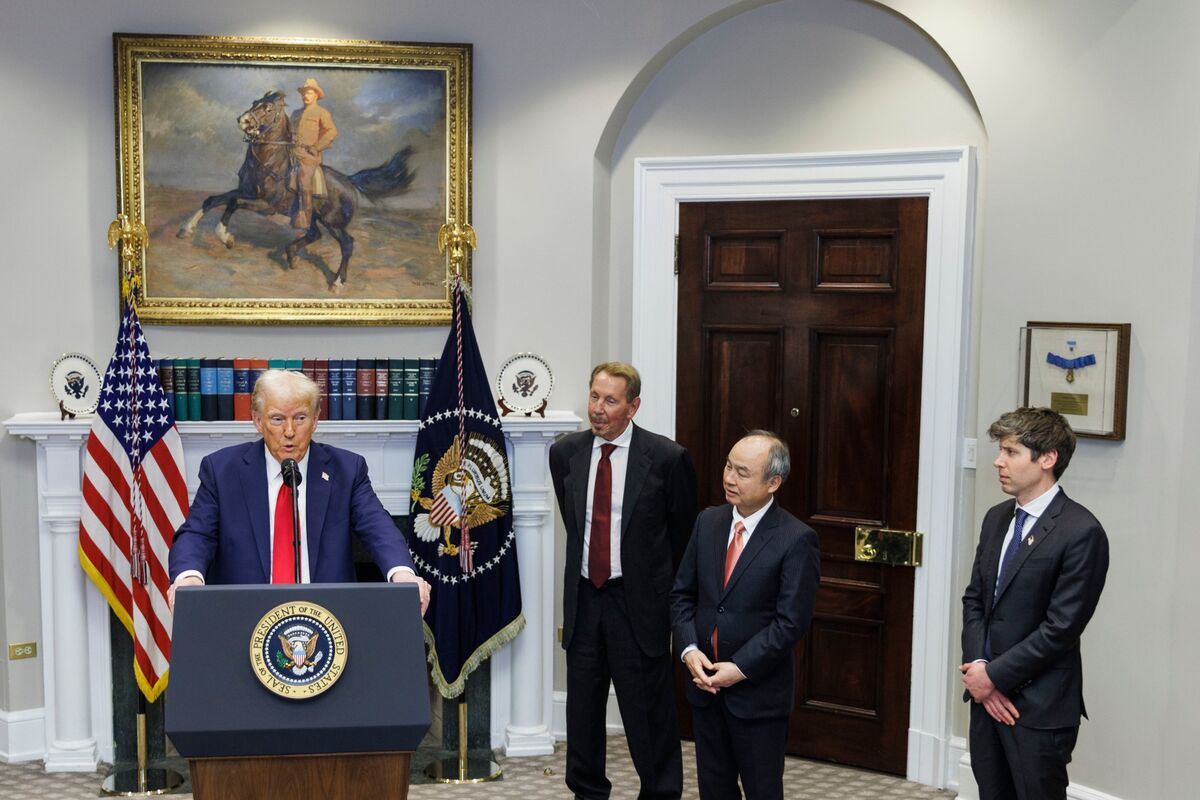
The Stargate initiative was officially unveiled during a high-profile news conference at the White House, where Trump was joined by OpenAI CEO Sam Altman, SoftBank Chairman and CEO Masayoshi Son, and Oracle Co-founder and Chairman Larry Ellison. Trump described the project as “the largest AI infrastructure project, by far, in history” and emphasized its role in maintaining US technological dominance.
Scaling to $500billion over four years
The initiative is structured as a joint venture, Stargate LLC, led by OpenAI, SoftBank, Oracle, and the Abu Dhabi-based investment firm MGX. The group committed an immediate $100billion investment, with plans to scale to $500billion over the next four years. NVIDIA, Microsoft, and Arm are key technology partners providing hardware and platform support. The project is projected to create over 100,000 American jobs almost immediately.
The announcement coincided with Trump rescinding a Biden-era executive order on AI, signaling a shift toward a less regulated, private-sector-led approach. A central goal is ensuring US leadership in AI to compete with China.
Jobs, Reindustrialization, Enterprise Accessibility
The project is expected to create over 100,000 American jobs almost immediately, specifically in construction, operations, and technical roles.
By establishing a nationwide network of high-tech campuses and data centers, Stargate aims to revitalize the US industrial sector and attract further global investment into American-led AI projects. The massive scale is intended to lower computing costs, providing startups and smaller businesses with access to high-powered AI resources that were previously cost-prohibitive.
Energy Infrastructure Transformation
Data centers are the fastest-growing factor in US electricity demand. Stargate sites are projected to require up to 10 gigawatts initially, necessitating massive investments in new energy generation. To protect local communities from price hikes, OpenAI and partners have pledged to fund their own power infrastructure, including solar, wind, battery storage, and even dedicated gas turbine plants.
The project is acting as a catalyst for new energy models, such as 1.2-gigawatt data centers in Texas supported by SB Energy to provide price-stable, low-emissions power.
AI dominance, sovereign AI, cybersecurity against China
A primary strategic goal is to ensure the US maintains “unquestioned and unchallenged” technological dominance over global competitors like China. By keeping advanced intellectual property, hardware (such as NVIDIA GB200 GPUs), and data assets within the US, the initiative seeks to protect national and military security.
Advanced AI capabilities developed through Stargate are expected to enhance US surveillance and data analysis to safeguard against strategic threats.
Medical Innovation, AGI, Scientific Discovery
AI leaders emphasize that this unprecedented compute power will be directed toward solving complex human problems, specifically aiming for breakthroughs in drug discovery and curing diseases like cancer. The infrastructure is intended to accelerate progress toward Artificial General Intelligence (AGI), which could revolutionize education through personalized learning and automate routine tasks to free human creativity.
Reactions
Shares of major infrastructure and chip companies, including Nvidia, Dell, and Super Micro, saw immediate gains following the announcement. Salesforce CEO Marc Benioff suggested the project could cause a rift between OpenAI and Microsoft as OpenAI looks to broaden its partnerships beyond its exclusive Microsoft cloud arrangement.
One of the most vocal critics, Elon Musk, repeatedly claimed that the backers “don’t actually have the money,” specifically alleging that SoftBank had less than $10billion secured. Sam Altman publicly countered these claims, calling Musk’s information “wrong.”
Analysts and tech critics questioned the feasibility of the $500billion target, noting OpenAI’s significant annual losses and the “circular” nature of the investment where suppliers like Nvidia are also investors. Legal experts, including those from Yale Law School, have argued that Stargate may violate antitrust laws by allowing competitors (like Oracle and Microsoft) to collaborate in ways that entrench market power and reduce future competition.
Over 200 environmental groups, including Greenpeace, have called for a moratorium on new data centers, citing concerns over massive water usage, carbon emissions, and rising electricity bills for average citizens.
China accelerates AI response
Following the announcement, reports emerged of China accelerating its own “Stargate” response, aimed at building mega-clusters and linking data centers to compete for AI supremacy.
Read also:
NVIDIA to build out $500b of AI infrastructure in the US
Apple announces additional $100B US investment following tariff threats