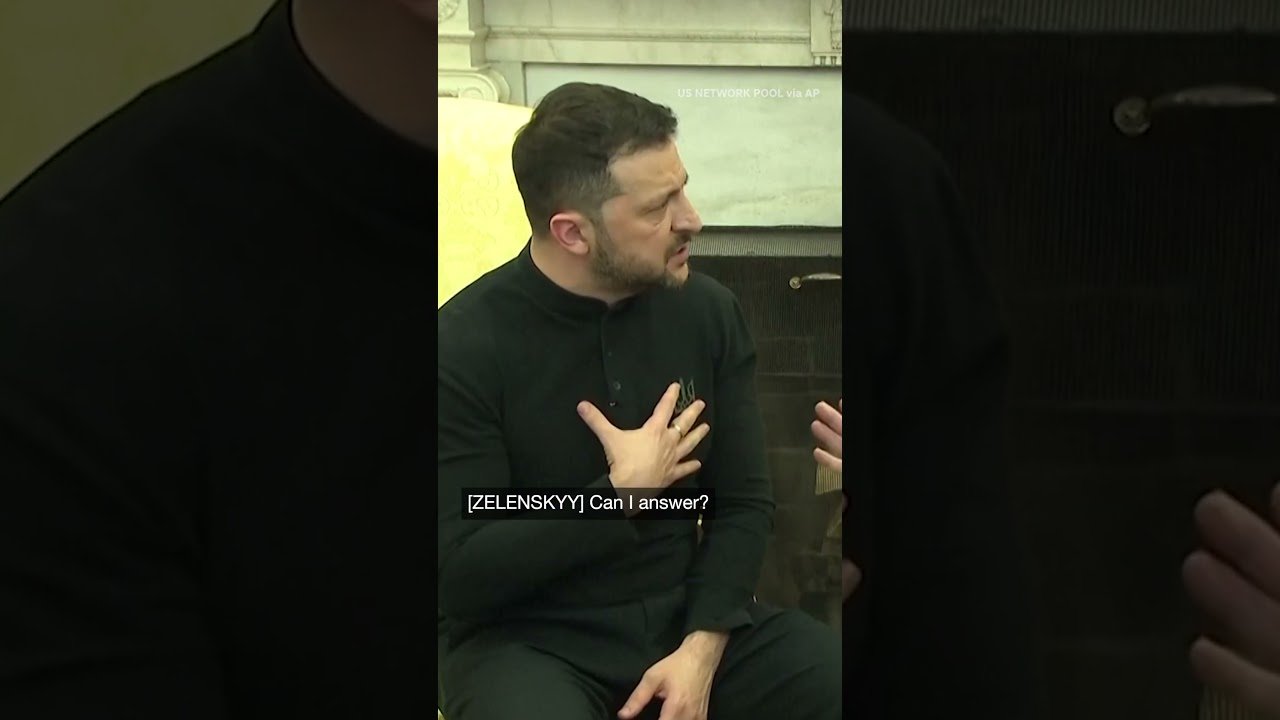
A tense White House meeting between President Donald Trump and Ukrainian President Volodymyr Zelenskyy on February 28 ended abruptly without a signed agreement after talks over a minerals deal collapsed into a heated exchange. The confrontation shifted the focus away from security guarantees and toward Trump’s demand for leverage over Ukraine’s strategic resources.
The Oval Office meeting was meant to finalize a strategic minerals deal and discuss a possible ceasefire with Russia, but it quickly unraveled into a public argument. Trump told Zelenskyy that Ukraine did not “have the cards” and accused him of “gambling with World War III” by refusing to compromise with Vladimir Putin.
Zelenskyy pushed back, arguing that Putin could not be trusted and telling Trump not to compromise with “a killer.” He also challenged Vice President JD Vance’s understanding of the war, saying Vance had never visited Ukraine.
Friction in the room
Trump and Vance both accused Zelenskyy of being disrespectful and insufficiently grateful for US aid, which Trump estimated at $350billion. White House officials also reportedly bristled at Zelenskyy’s choice of combat-style attire rather than a suit and his use of “JD” rather than “Mr. Vice President.”
The planned joint press conference and minerals deal signing were canceled, and Zelenskyy was asked to leave the White House early. Trump later said on Truth Social that Zelenskyy was “not ready for peace” and should return only when he was.
Freeze on US military aid to Ukraine
Zelenskyy later told Fox News the exchange was “not good” but said he believed relations could still be repaired. European leaders, including Emmanuel Macron and Keir Starmer, publicly backed Zelenskyy, while Russian officials praised Trump’s posture.
Trump then ordered a freeze on military aid to Ukraine, and the White House directed the Pentagon to pause pending shipments of weapons and ammunition. Analysts warned the halt could quickly weaken Ukraine’s battlefield position, especially in artillery and air defense.
Europe responds
In response to the US pullback, Keir Starmer convened an emergency summit in London on March 3, 2025, with leaders from Britain, France, Poland, Germany and the Nordic states. The gathering focused on creating a European security backstop, including a proposed €50billion emergency fund and new plans for joint weapons production.
The meeting underscored how sharply the transatlantic alliance had frayed. For Europe, the clash in Washington was not just a diplomatic rupture but a warning that future support for Ukraine could no longer be assumed.
Read also:
Trump proposes Ukraine Peace Plan
Ukraine’s $100M Corruption Scandal