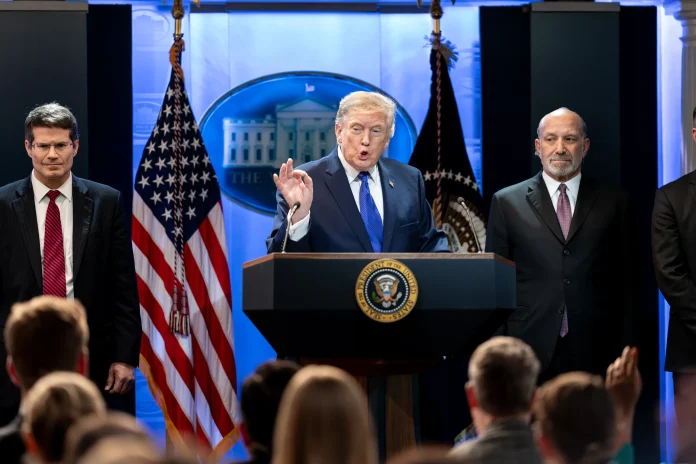
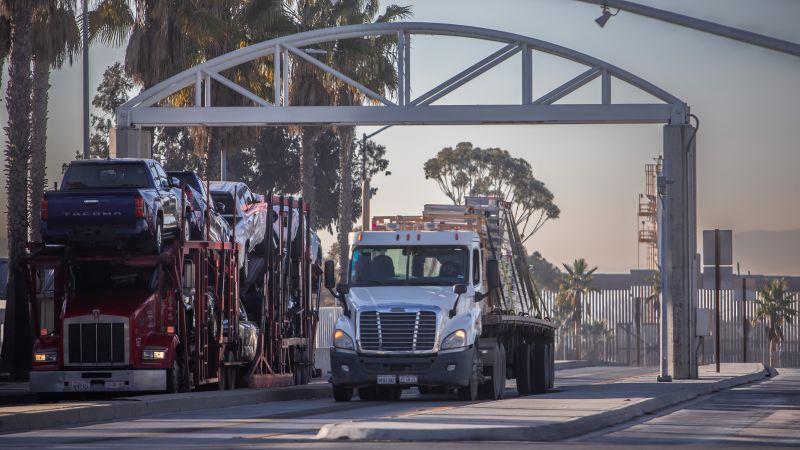
In early February 2025, President Donald Trump signed executive orders imposing sweeping new tariffs on the United States’ top three trading partners — Mexico, Canada, and China — citing national emergencies related to illegal immigration and the flow of illicit fentanyl.
On February 1, 2025, Trump signed executive orders imposing an additional 25% tariff on goods from Canada and Mexico and an additional 10% tariff on all imports from China, intended to “stack” on top of existing duties from his first term.
While the 10% tariff on China took effect as scheduled on February 4, Trump agreed to a 30-day pause for Canada and Mexico following emergency talks with Prime Minister Justin Trudeau and President Claudia Sheinbaum.
25% tariffs on Canada, Mexico; China tariff doubles to 20%
Following the pause, the 25% tariffs on Canada and Mexico officially went into effect on March 4. On the same day, the tariff on Chinese goods was increased further from 10% to 20%. Shortly after implementation, the administration exempted goods that strictly qualify under the USMCA (United States-Mexico-Canada Agreement) from these specific “fentanyl” tariffs.
Separately, on February 10, Trump signed proclamations reinstating or increasing global tariffs on steel (25%) and aluminum (25%), which took effect on March 12, 2025.
Economists noted that these measures could result in “stagflation,” which can result in higher consumer prices for groceries and gasoline combined with reduced US GDP growth.
National emergency over immigration, fentanyl trafficking
President Trump invoked the International Emergency Economic Powers Act (IEEPA), a national security statute, to implement the tariffs. The administration held Mexico and Canada accountable for what it described as a failure to stop the “invasion” of illegal aliens across US borders.
The tariffs also aimed to combat the flow of deadly fentanyl into the US, which the administration stated constituted a national public health crisis. Mexico was accused of affording safe havens to cartels, and China was accused of failing to curb the flow of precursor chemicals.
Canada: Dollar-for-dollar retaliation
Canada implemented a dollar-for-dollar retaliation strategy, targeting roughly C$155billion of US goods to match the scale of the American tariffs. 25% tariffs were applied to $30billion of US consumer goods, including high-visibility items like orange juice, peanut butter, bourbon, wine, spirits, coffee, household appliances, and apparel.
These were strategically chosen to hit industries in politically influential states — such as Florida’s orange industry and Kentucky’s bourbon distilleries — to pressure Washington. In response to Trump’s global metal tariffs, Canada added 25% tariffs on another $29.8billion of US steel, aluminum, and related consumer products on March 13, 2025.
On April 9, 2025, Canada imposed 25% tariffs on approximately $35.6billion worth of US-made vehicles and auto parts that were not compliant with the USMCA. After the US exempted USMCA-compliant goods, Canada removed most of its counter-tariffs on consumer products in September 2025.
As of early 2026, Canada maintains 25% tariffs on US steel, aluminum and automobiles, as the US has not provided a similar exemption for these specific sectors.
Mexico: USMCA exemption avoids full tariff war
Immediately after President Trump signed the executive orders on February 1, President Claudia Sheinbaum ordered her economy minister to prepare a “Plan B” involving retaliatory tariffs on US goods to defend Mexican interests.
Unlike Canada, which enacted its first phase of tariffs immediately, Sheinbaum repeatedly delayed Mexico’s formal implementation to prioritize dialogue. She stated that “problems are not resolved by imposing tariffs.”
During a February 3 talk, Mexico secured a one-month pause on the tariffs by committing to deploy 10,000 National Guard troops to its northern border to help curb the flow of fentanyl and illegal migration. When the US 25% tariffs officially took effect on March 4, 2025, Sheinbaum again condemned the move and scheduled a formal announcement of retaliation for March 9.
On March 6, 2025, the Trump administration announced that goods strictly qualifying under the USMCA would be exempted from these specific 25% tariffs. Because the vast majority of Mexican exports (over 84%) qualified for the USMCA exemption and remained tariff-free, Mexico largely avoided a full-scale “tariff war” through the remainder of 2025.
Had Mexico moved forward with full retaliation, its prepared list included duties ranging from 5% to 20% on US pork, cheese, fresh produce, steel, and aluminum, while notably planning to exempt the automotive industry to protect its own manufacturing base.
China: Tit-for-Tat Escalation to 125% Tariffs
China implemented a “tit-for-tat” strategy that escalated alongside US hikes. In response to the initial US 10% tariff, China applied 15% duties on US coal and liquefied natural gas (LNG), and 10% on crude oil, agricultural machinery, and large pickup trucks.
After the US doubled its fentanyl-related tariffs to 20%, China retaliated with 15% tariffs on chicken, wheat, corn, and cotton, plus 10% on soybeans, pork, beef, and dairy. Following the US “Liberation Day” tariffs, China’s baseline retaliatory rate reached 84%, eventually peaking at 125% by mid-April.
Following a meeting between President Trump and President Xi Jinping in late October 2025, the two countries reached a significant truce. Effective November 10, 2025, the US lowered its cumulative fentanyl and reciprocal tariffs back to 10%.
In response, China suspended all retaliatory tariffs and non-tariff measures announced since March 2025. China agreed to resume large-scale purchases of American farm products, specifically committing to buy 12 million metric tons of soybeans in late 2025. China committed to stricter controls on fentanyl precursors, while the US secured the elimination of China’s proposed export controls on rare earth minerals.
Read also:
US-China trade war reaches one-year truce
Trump declares Liberation Day in 2025